MESOP MIDEAST WATCH: FRANK WALTER & DER LIBANESISCHE WAFFENHÄNDLER

Teure Präsentkörbe Die lahmen Ausreden des Frank-Walter Steinmeier

Bundespräsident Frank-Walter Steinmeier flüchtet sich in Ausreden, findet Reporter Hans-Martin Tillack von Hans-Martin Tillack  DER STERN 26.09.2019

Der heutige Bundespräsident stand wiederholt auf der Geschenkeliste eines Waffenhändlers. Weil Steinmeier auf diese Enthüllung mit Ausflüchten reagiert, liefert er seinen Kritikern unnötige Munition.

weiterlesen / click to continue

MESOP MIDEAST WATCH: Iranian president says Tehran has ‘little hope’ for Vienna nuclear talks

“We put our hopes on the east, west, north, south of our country and never have any hope in Vienna and New York,” Iranian President Ebrahim Raisi says in a speech commemorating the 43rd anniversary of Iran’s Islamic Revolution.By  ISRAEL HAYOM 2-13-2022

weiterlesen / click to continue

THEO VAN GOGH GESELLSCHAFT: VON SPD & GRÜNEN GEPLANTE MIGRANTEN-GETTO AUF WIESEN ENTLANG DER A 5 DROHT ZU SCHEITERN

13-2-2022 Jetzt kommen sogar Reporter der SPD nahen Frankfurter Rundschau zu der Einsicht, dass es mit dem grenzenlosen Wachstum und dem damit einhergehenden Raubbau an den lebenswichtigen Ressourcen Wasser und Ackerland durch die Frankfurter nicht mehr so weitergehen kann!

weiterlesen / click to continue

MESOP MIDEAST WATCH | Iraqi Army Removes Picture of PKK’s Ocalan in Sinjar

RUDAW 12.2.2022 ERBIL — Iraqi Army forces on Saturday removed a picture of Abdulla Ocalan, the jailed leader of the Kurdistan Workers’ Party (PKK), from a street in the Yezidi town of Sinjar, northwest of Mosul.

weiterlesen / click to continue

MESOP MIDEAST WATCH: IRAN TAKES NEXT STEPS ON ROCKET TECHNOLOGY

by Farzin Nadimi PolicyWatch 3576Feb11, 2022

Solid-propellant motors represent the future for the Islamic Republic, promising much longer ranges and orbit reach for its space and ballistic missile programs.

weiterlesen / click to continue

THEO VN GOGH NEWS: Between Russia and Ukraine, Americans say either stay out or side with Ukraine – CBS News poll

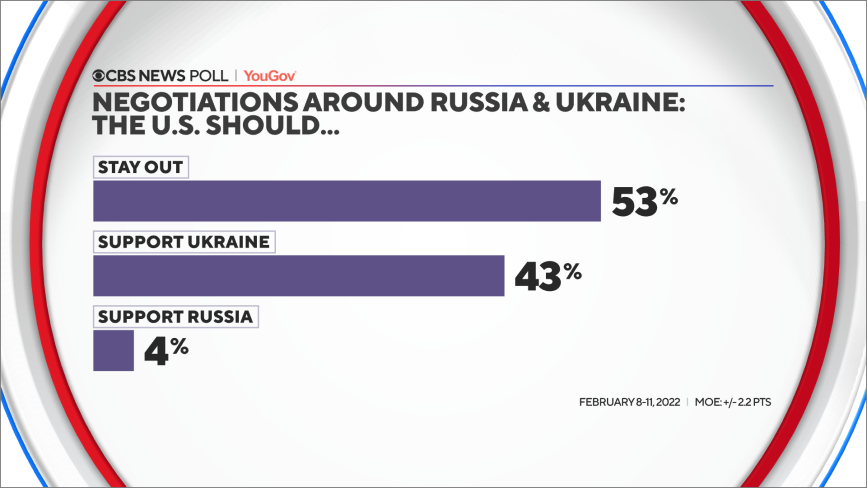
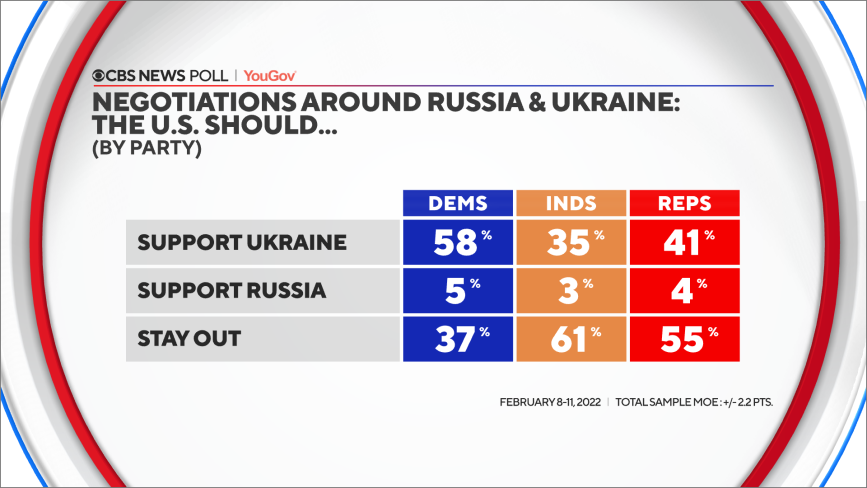
A slight majority of Americans would prefer the U.S. stay out of any negotiations around the situation with Russia and Ukraine, while those who would take a side say the U.S. should stand with Ukraine. They cite stopping further Russian influence in the region and defending democracy as top reasons.The proportion saying that the U.S. should stay out is driven by Republicans and independents, while more Democrats feel the U.S. should side with Ukraine.

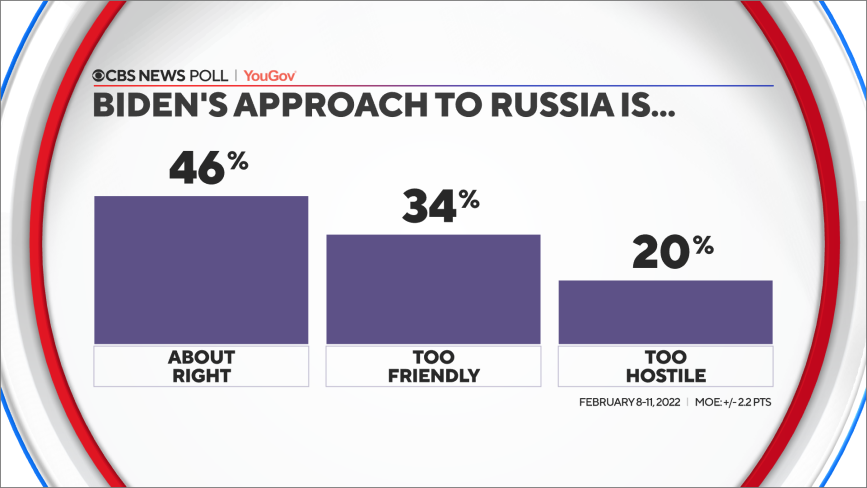
Meanwhile, President Biden gets mixed marks on his approach toward Russia.
30-russia-ukraine-total.png

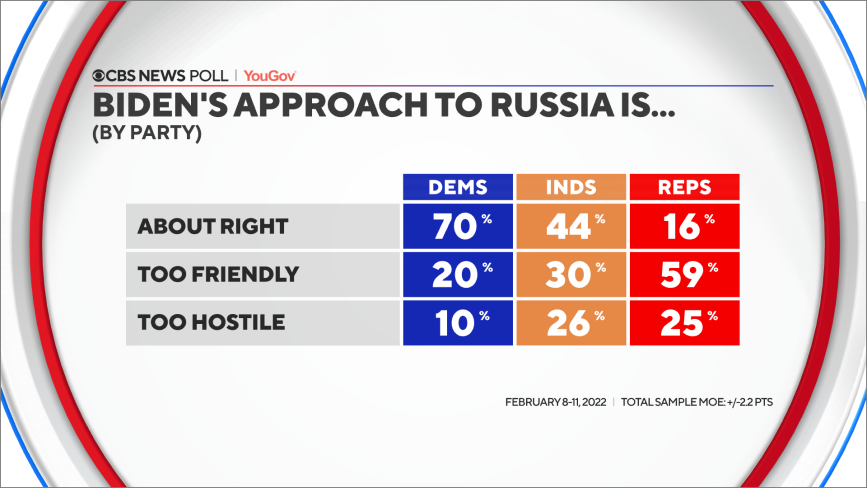
Democrats and a plurality of independents think Mr. Biden’s approach is right. While Republicans would prefer the U.S. stay out of the Russia-Ukraine situation, at the same time, they are critical of Mr. Biden’s approach to Russia, with most Republicans calling it “too friendly,” and a quarter calling it “too hostile.” They overwhelmingly disapprove of how he is handling issues with Russia more broadly.
33-biden-approach-russia-total.png
34-biden-approach-russia-party.png

Beyond partisanship, there are generational differences, too. There is more support for U.S. siding with Ukraine among older Americans, whose views may be shaped by memories of the Cold War. Younger Americans, particularly those under age 30, are inclined to feel the U.S. should stay out of the situation.
31-russia-ukraine-party.png

Some of this generational divide in views concerning Russia was evident in CBS News polling conducted in June ahead of President Biden’s summit with Russian President Vladimir Putin. In that poll, it was Americans 65 and over who held the most negative views of Russia — eight in 10 calling the country unfriendly or an enemy to the U.S. Americans under 30 were the least likely to describe Russia that way — nearly half of this group said the country was an ally or friendly to the U.S.
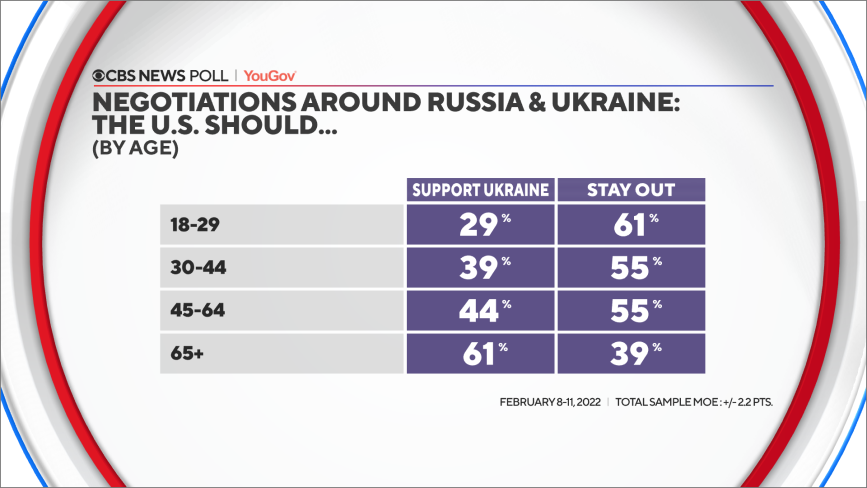
32-russia-ukraine-age.png

There was reluctance on the part of the American public to intervene in 2014, when Russia annexed Crimea. Back then, most Americans did not think the U.S had a responsibility to do something in that situation.
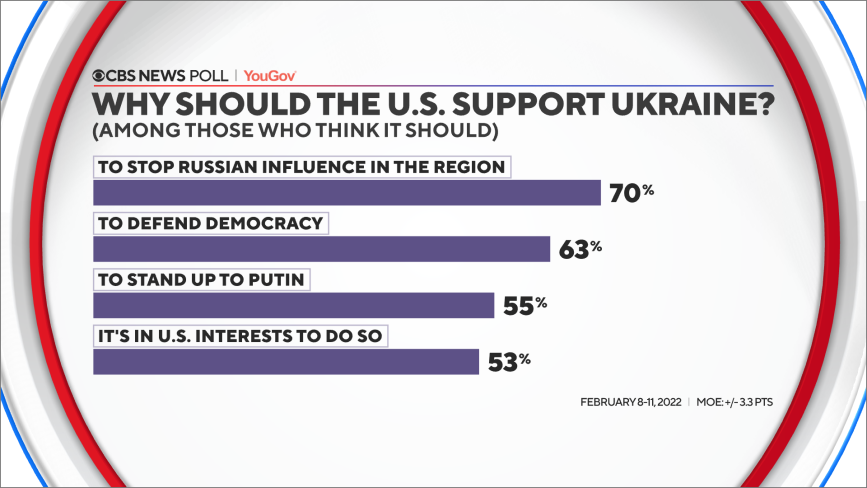
35-why-ukraine.png

This CBS News/YouGov survey was conducted with a nationally representative sample of 2,578 U.S. adult residents interviewed between February 8-11, 2022. The sample was weighted according to gender, age, race, and education based on the U.S. Census American Community Survey and Current Population Survey, as well as to 2020 presidential vote. The margin of error is ±2.2 points.

THEO VAN GOGH SOCIETY – Ausgestoßene der Woche: Trucker &Podcasts

Die Crowdfunding-Plattform GoFundMe will dem Freedom Convoy Spenden in Höhe von etwa 10 Millionen kanadischen Dollar vorenthalten. Das Geld soll an „glaubwürdige“ Wohltätigkeitsorganisationen verteilt oder den Spendern zurückerstattet werden. von Kolja Zydatiss 12-2-2022

weiterlesen / click to continue

THEO VAN GOGH SOCIETY: DER LETZTE STAND DER DINGE / UKRAINE

DIE WELT ! 12-2-2022 Biden warnt Putin vor „hohen Kosten“ im Fall einer Invasion

Rund eine Stunde hat Joe Biden am Samstag mit Wladimir Putin telefoniert.

weiterlesen / click to continue

THEO VAN GOGH SOCIETY :  Putins Aufsatz über die Ukraine – Der historische Plan hinter den russischen Manövern   Kommentar von Joseph Croitoru

12.02.2022 –  2021 erschien unter dem Namen von Wladimir Putin ein Aufsatz zur Geschichte Russlands und der Ukraine. Zwei Historiker haben den Text jetzt kommentiert, in dem der russische Präsident das ukrainische Volk umgarnt und das alte Feindbild Deutschland beschwört.

weiterlesen / click to continue

MESOP MIDEAST WATCH: Islamic State still ‘global operation,’ says Pentagon report

 
12-2-2022 – Islamic State ‘entrenched’ in Iraq and Syria

According to the latest Pentagon Inspector General report, the Islamic State “claimed fewer attacks in Iraq and Syria but remained entrenched in remote, rugged areas.”

IS also continued to provoke sectarian, ethnic and tribal divisions in both Iraq and Syria. In Iraq, IS attacks increased in areas disputed between the federal government and the Kurdistan region.

The quarterly report on Operation Inherent Resolve, the name of the US military mission to defeat IS in Iraq and Syria and set conditions for long-term security cooperation, covers the period from Oct. 1 to Dec. 31, 2021. The report was published on Feb. 8, just five days after the US special forces operation in Idlib province in northern Syria that led to the death of IS leader  Abu Ibrahim al-Hashimi al-Qurayshi.

Seven quick takeaways

  • The United States maintains approximately 2,500 troops in Iraq and 900 in Syria. The US mission in Iraq transitioned from combat to “advising, assisting, and enabling” Iraqi security forces on Dec. 31.
  • There are 1.2 million internally displaced people and 252,000 Syrian refugees in Iraq (out of a population of 40 million), and 6.8 million IDPs in Syria (out of 17.5 million).
  • IS has “incorporated existing jihadist groups or upstart elements into its global organization, expanding into the Arabian Peninsula, South and Southeast Asia, Eurasia, Turkey, and Africa,” providing “the group’s branches with guidance, media support, and funding,” which it derives increasingly from criminal activities.
  • Despite prior leadership losses (before the killing of Qurayshi), IS showed “few signs of major fracturing or disaggregation” during the quarter.
  • IS “continued to prioritize freeing its members detained in Iraq and Syria,” foreshadowing the massive attack on al-Sinaa prison in Syria on Jan. 20-21. Sultan al-Kanj, Shelly Kittleson reporting from Iraq, Jared Szuba reporting from Washington and Amberin Zaman have scoops and analysis on the jailbreak and its aftermath.
  • Both the Syrian Democratic Forces (SDF) and the Iraqi military showed improvement in capabilities, but still depend on coalition support for combat and intelligence operations.
  • Concluding its review of Syria policy in December, the Biden administration said it “will continue to focus on core policy priorities.” They include the campaign against IS, supporting local cease-fires, expanding humanitarian access into and throughout the country, “pressing for accountability and respect for international law while promoting human rights and nonproliferation, including through the imposition of targeted sanctions, and supporting a political process led by the Syrian people, as envisioned in UN Security Council Resolution (UNSCR) 2254.”

Killing of Qurayhsi leads to questions on Turkish role

US President Joe Biden praised the “essential partnership” of the SDF in carrying out the operation that killed Qurayhsi. He also mentioned the Iraqi security forces and the Iraqi Kurdish Peshmerga.

Conspicuously not mentioned was any Turkish role in the operation, even though “Qurayshi was hiding in a house near the northern Syrian town of Atmeh, a stone’s throw from the border across the Turkish province of Hatay and only a few hundred meters from Turkey’s Bukulmez military outpost, which overlooks the region,” writes Fehim Tastekin.

Although the region is out of the control of Turkey and its proxy forces in Syria, “Atmeh and nearby villages can be easily monitored from the military watchtower at Bukulmez outpost,” adds Tastekin, and “Given the intelligence leaks that suggest Qurayshi was also relying on a web of couriers to lead the group like his predecessor, Turkey’s failure to identify the suspicious mobility in the region is raising further questions.”

“According to Kasim Guler, the alleged IS leader for Turkey whose confessions to the Turkish authorities were leaked to the media last week, [former IS leader Abu Bakr] al-Baghdadi had made a decision to use Turkey as a major base.”

Other accounts paint a more active and complex picture of Turkish counter-IS operations.

The Pentagon report noted that according to “media accounts,” Turkey and Turkish-supported Syrian armed opposition groups “conducted operations against ISIS during the quarter in areas they control” and “Turkish intelligence assisted Iraq in the capture of senior ISIS leader Sami Jasim in northwestern Syria.”

Khaled al-Khateb reported from Aleppo less than a week before the Qurayshi operation, “The Turkish-backed Syrian opposition has waged a security campaign against Islamic State cells in Azaz in the northern Aleppo countryside since Jan. 20, leading to the arrest of dozens of IS members and collaborators. The hunt for other members is expected to continue through the confessions of their fellows.”

Meanwhile in Idlib

Idlib province, where the operation against Qurayshi took place, is mostly under the control of the “Salvation Government” led by Jihadist group Hayat Tahrir Al-Sham (HTS), an offshoot of al-Qaeda that was designated a terrorist organization in 2018 by the United StatesTurkey, and the UN Security Council.

HTS claims it has cut ties with al-Qaeda and its leader, Mohammed al-Golani, has been on a public relations campaign the past two years to shake the terrorist label and reposition HTS as freedom fighters holding the line against the Syrian government, shedding his robes and ideological rhetoric for Western suits.

Five updates from our regional reporters

  • Residents of displacement camps near the site of the US operation that killed Qurayshi are still traumatized and terrified not only of a possible return by the Islamic State, but also by the US-led coalition, writes Mouneb Taim from Idlib.
  • The continued decline of financial and logistical support hospitals in Idlib is leading to a humanitarian catastrophe, Taim reports.
  • Golani recently offered $1 million to provide heating to displaced families affected by cold winter weather, provoking “widespread controversy and criticism on social media, with activists mocking him for trying to appear as a humanitarian activist instead of a military leader,” writes Sultan al-Kanj.
  • HTS has stepped up its arrest campaign against al-Qaeda-affiliated Hurras al-Din, a rival of HTS in Idlib, Kanj reports.
  • Amid deteriorating conditions in Idlib’s public schools, religious schools have proliferated across the area, reports Mohammed Hardan.


« neuere Artikel / next articles   ältere Artikel / previous articles »