Steven Nabil@thestevennabil
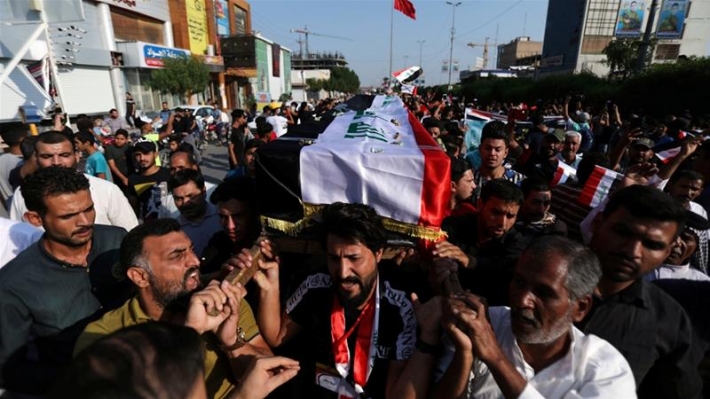
Everytime there is a government push against protesters in Nasriya a large human waves comes out of nowhere and rushes back the security forces. Nasriyah is a tough place to overpower for the Iraqi government #Iraq
https://twitter.com/i/status/1221383713868566529
Alex Mello Retweeted – Hayder حيدر@HayderSH
26 Jan 2020 – 17m
I can promise you If #Iraq’s young protesters had the same amount of resources, support and facilitation as other protesters “whose only demand was to get US out of Iraq” then we would see millions in #Baghdad.
More via www.mesop.de
US President Donald Trump met Kurdistan Region President Nechirvan Barzani at Davos. Barzani’s office wrote the following about the meeting. “On the sidelines of the summit, President Nechirvan Barzani held meetings with U.S. President Donald Trump and the United Nations’ Secretary General Antonio Guterres. The President is also expected to meet with a number of other world leaders, ministers and high ranking officials. In the meetings, the President is expected to focus on strengthening Kurdistan Region’s relations with the international community and to convey the policies and position of Kurdistan Region on regional and world affairs.”
Barzani discussed the “Unsettled Middle East.” In his address, he spoke about the enduring impact of continuous unrest and crises in the Middle East, which have caused deep fear and concern around the world and in the region. The president will also shed light on how the current crisis is impacting peace and stability in the Gulf, Iraq and Syria.
The KRG has emphasized the importance of continuing anti-ISIS operations and wants to continue to work closely with the US and CJTOIR.
Barzani met Jordanian, Greek and UN officials at Davos.
|
|
|
|
|
Pompeo spoke to NPR on Friday in an interview that later raised controversy about US Ukraine policy.
By SETH J. FRANTZMAN JANUARY 25, 2020 02:59 – JERUSALEM POST
US Secretary of State Mike Pompeo slammed Iran for funding Iraqi Shi’ite militias, Hamas, Hezbollah in an interview Friday. The US is working to convince Iran that its model of using proxies, terror campaigns, assassinations in Europe and an assassination attempt “right here in Washington” is “not tolerable,” Pompeo said.
weiterlesen / click to continue
By Katherine Lawlor and Brandon Wallace 25 Jan 2020 – INSTITUTE FOR THE STUDY OF WAR
Key Takeaway: Iran’s proxy militia network and Iraqi nationalist Shi’a cleric Moqtada al-Sadr coordinated a “million-strong” anti-U.S. march in Baghdad on January 24. The march remained peaceful despite fears of clashes between supporters of the march and pre-existing protests.[1] Sadr and Iran’s proxies deliberately chose a location for their march away from the separate, popular anti-government protests which have persisted since October 2019. American policymakers should not perceive the January 24 march as representative of all Iraqis or as a political mandate that warrants abandoning U.S. security commitments to Iraq. The relative success of the anti-U.S. march is unlikely to significantly alter the character or core objectives of Iraq’s pre-existing protest movement, which include a unified and sovereign Iraq free from sectarian divides, corrupt elites, and foreign interference from all actors, including Iran and the United States.
Nationalist Shi’a cleric Moqtada al-Sadr and Iran’s Iraqi proxy network convened an estimated 250,000 anti-U.S. demonstrators in Baghdad on January 24.[2] This march is not a reflection of the popular, persistent protest in Iraq, which has been much larger in scale and geographic reach. The march was instead a deliberate, contrived show of political force directed at the United States. weiterlesen / click to continue
By Katherine Lawlor with Brandon Wallace – 23 Jan 2020 INSTITUTE FOR THE STUDY OF WAR
Key Takeaway: Iran is organizing a new effort to increase political and military pressure against U.S. forces in an effort to compel an American withdrawal from Iraq. Iran’s proxy militia groups are working with Iraqi nationalist Shi’a cleric Moqtada al-Sadr to organize a “million strong march” on January 24 to oppose the U.S. troop presence in Iraq. Sadr’s support lends additional credibility to the march and may enable Iran’s proxies to generate a more significant protest than they otherwise would be able to achieve. Iran is also attempting to coalesce its lethal Iraqi proxy militias, and potentially Sadr, into a more unified military force to target U.S. forces in the region. Iran faces some obstacles in doing so, but the formation of an anti-U.S. Iraqi resistance front poses a significant threat, even in its preliminary stages of organization.
weiterlesen / click to continue
by Michael Knights Policy Alert January 23, 2020 – To ensure that new protests, new sanctions, and new political leadership wind up helping rather than hindering Iraqi sovereignty, Washington must handle upcoming developments with great care.
In the coming weeks, Iraq’s parliament may appoint a replacement for Prime Minister Adil Abdulmahdi. This is a very positive development, since the country’s sundry Iranian-backed militias would like nothing better than to keep the discredited leader under their thumb as an open-ended caretaker premier following his November resignation. In contrast, a new leader with a new mandate could get the government moving again, pass a budget, bring the criminals responsible for killing protestors to justice, and assuage angry protestors by making visible preparations for early, free, and fair elections—thereby remedying the results of the widely disparaged 2018 vote.
weiterlesen / click to continue
Lawk Ghafuri@LawkGhafuri
22 Jan 2020
Secretary General of Asaib Ahl al-Haq, Qais al-Khazaali, joins Shiite cleric Muqtada al-Sadr & calls on Sunnis, Shia & Kurds to storm the streets on Friday against the “invaders” US troops. This message was recorded after President
@BarhamSalih met w/ @realDonaldTrump at #WEF20.
More via www.mesop.de
MESOPOTAMIA NEWS TODAYS RECOMMENDATION / Article BY ZACH HUFF !
Zach D. Huff – BREITBART – 21 Jan 202061 – 7:29 – Incensed Iraqi Kurdish officials last week hit back at taunts from Hezbollah chief Hassan Nasrallah, who lashed out at former Iraqi Kurdistan Region (KRG) President Masoud Barzani and Kurdish Peshmerga forces.
During a live broadcast on January 13 vowing revenge for the recently-slain Maj. Gen. Qassem Soleimani, Nasrallah minimized the Kurds’ role in defeating ISIS — while claiming credit for Iran and its affiliate proxy militants in Iraq.
Soleimani, the head of the Islamic Revolutionary Guard Corps (IRGC) Quds Force, managed Iran’s external terrorism operations before an American airstrike eliminated him from the battlefield this month.
“When Kurdistan was falling into the hands of ISIL [the Islamic State] and no one agreed to help you, the only one who responded to your call was Haj Qassem Suleimani, who arrived the next day along with officials from Hezbollah to Erbil,” said Nasrallah, adding that, “when the Islamic State was attacking, [President Masoud] Barzani was shivering from fear.”
weiterlesen / click to continue
 BasNews 21/01/2020 – 02:09 Published in Iraq ERBIL – The Amnesty International has blamed the Iraqi security forces for the way they deal with the protesters, saying that they meet the demonstrators “with violence”.
“Disheartening reports that the security forces once again meet protesters with violence in Baghdad,” it said in a statement on Monday.
The Amnesty International also argued that the Iraqi security forces should protect the demonstrators, adding that: “It is the right of every #Iraqi to be allowed to protest peacefully. It is the duty of Iraqi security forces to protect that right.”
Iraq has been suffering from anti-government protests in the capital Baghdad and other southern cities since the beginning of October.
Hundreds of protesters have been killed, and more than 25,000 others have been injured, Iraq’s High Commission of Human Rights has said
« neuere Artikel / next articles ältere Artikel / previous articles »