MESOPOTAMIA NEWS REPORT : An attack on US-led Coalition at Camp Taji, March 11, 2020: Escalation and questions of deterrence

By SETH J. FRANTZMAN  MECRA  12 March 2020 –

A rocket attack on Camp Taji Iraq on march 11 has killed Americans and has led to tensions in Iraq. CENTCOM says “Three Coalition personnel were killed during a rocket attack on Camp Taji, Iraq, March 11. Approximately 12 additional personnel were wounded during the attack. The attack is under investigation by the Coalition and Iraqi Security Forces. Camp Taji is an Iraqi base that hosts Coalition personnel for training and advising missions. Approximately 18 107mm Katyusha rockets struck the base.  The Iraqi Security Forces found a rocket-rigged truck, a few miles from Camp Taji.”

It is the latest of numerous attacks in Iraq as US-Iran tensions rose over the last year. In December a US contractor was killed at K-1 near Kirkuk. The US responded to the December rocket fire with attacks on five Kataib Hezbollah targets. In response pro-Iranian groups, many linked to the Popular Mobilization Units, stormed the US embassy compound, setting the stage for the current escalation. The Middle East Center for Reporting and Analysis (MECRA) has profiled past attacks as well as ongoing protests in Iraq and Iranian-backed paramilitaries in Iraq. The following is the background and assessment about the current serious incident.

Background

On January 1 US Secretary of State Mike Pompeo wrote “the attack today was orchestrated by terrorists – Abu Mahdi al Muhandis and Qays al-Khazali – and abetted by Iranian proxies – Hadi al Amari and Faleh al-Fayyad. All are pictured below outside our embassy.”

Two days later, on January 3, a US airstrike killed Qasem Soleimani and Abu Mahdi al-Muhandis.

On January 8 Iran fired ballistic missiles at Ayn al-Assad base in Iraq. “Satellite photos taken Wednesday show that an Iranian missile strike has caused extensive damage at the Ain al-Assad air base in Iraq, which hosts U.S. and coalition troops,” noted NPR.

Since January 8 another series of attacks have been made on bases where US forces are located and against the Green Zone, particularly Union III, in Baghdad. “Rocket attack alarms sounding off multiple times on the #US #Baghdad Embassy Complex and Union III. Heard the booms myself on Union III. Speakers telling all to take shelter immediately,” wrote Nafiseh Kohnavard on January 20.

Muqtada al-Sadr, leader of Iraq’s largest political party, coordinating with Hadi al-Amiri of Badr, pushed for a million-person anti-US march in January. The protesters massed on January 24. Sadr had previously met with PMU members in Qom where he was living in Iran. Harakat Hezbollah al-Nujaba posted photos. “shiite cleric Muqtada al-Sadr meets w/ the Islamic resistance armed forces of #Iraq who are Iranian backed in Sadr’s office in Qom in central #Iran today to discuss the expelling of the #US troops from Iraq according to Al-Nujaba pro-Iran militia source,” noted Lawk Ghafuri on January 13. In the mean time Hezbollah sent Sheikh Mohammed al-Kawtharani. He had been in Iraq already since early January.

Recent threats against US forces

In early February, Nujaba sent its leader Akram al-Kaabi to Iran. He said “Our decision to start the countdown to achieve sovereignty and respond to the American occupation forces militarily is an Iraqi decision with distinction, and we will not allow interference from any party, and we apologize for the response to any external or internal request to postpone it even from friends, with our respect for all blood and belief partners, and it will be in the name of the martyr commander.” Nujaba threatened US forces at Ayn al-Assad with videos.

On February 5 US CENTCOM General Kenneth McKenzie met with Iraq’s Prime Minister at Balad air force base. Pro-Iranian groups referred to Mckenzie as a “terrorist.” Pro-Iranian groups claimed “in despite of parliament’s resolution and politicians and groups of #Iraq demand in #US leaving Iraq, USA is planning to expand its bases in #Kurdistan and setting air defense systems in other Iraqi bases.” On March 11 reports emerged that the US had finally figured out how to bring air defense to Iraq. “We are in the process of bringing air defense systems, ballistic missile defense systems into Iraq – particularly to protect ourselves against another potential Iranian attack,” CENTCOM Gen. McKenzie said. Two US Marine Raiders had just been killed fighting ISIS.

On the last day in February Abu Ali al Askari, the security official for Kataib Hezbollah said on Twitter that he was warning Iraqis working with Americans in the country. “Owners of Iraqi transportation and security companies…a final and irreversible warning.” This formed part of a series of warnings from Kaabi, Amiri, Qais Khazali of Asaib Ahl al-Haq and others.

We have profiled the appointment of Abu Fadak to replace Abu Mahdi al-Muhandis and the growing tensions with Iran. On March 8 Iran’s head of the Supreme National Security Council travelled to Iraq where he “met and held talks with Iraq’s National Security Adviser and the head of the PMU Falih alFayadh in Baghdad on Sunday.” His goal was to continue the countdown to removing US forces, reports said. During his trip IRNA notes “During his two-day visit to Iraq, Shamkhani held talks with leaders of the Iraqi political parties and secretary general of the Badr Organization Hadi al-Amiri.” See our previous analysis on this visit. See Iranian media coverage of his trip.

The US has identified Iran’s role in Iraq in its quarterly IG report

March 11

On March 11 the situation escalated. US-led Coalition spokesman Col. Myles Caggins wrote that “The Coalition confirms more than 15 small rockets impacted Iraq’s Camp Taji base hosting Coalition troops, March 11 at 7:35 p.m. (Iraq Time). Assessment and investigation ongoing.”

Brett McGurk noted “Troubling reports of American and British casualties after a rocket attack in north-central Iraq. Before last fall there had been no such rocket attacks in nearly eight years. Now they are happening nearly every week. My thoughts are with our people and partners under fire.” Iran’s Press TV says “Nearly a dozen Katyusha rockets have hit a military base housing American troops near the Iraqi capital Baghdad, but there were no immediate reports about anyone wounded or any damage caused in the attack.” Stars and Stripes reported Two Americans and one Briton were killed in a barrage of more than 15 “small rockets” that struck Iraq’s Camp Taji, north of Baghdad, where U.S. and other coalition troops are based, a security official said Wednesday.”
weiterlesen / click to continue

MESOPOTAMIA NEWS SAD NEWS : Two US solders killed in anti-ISIS op in Iraq

by Seth Frantzman  9 March 2020

Two Americans were killed in Iraq during a raid on ISIS  near Makhmour. Reports note “they were apart of a Marine Special Operations Team and were clearing a well-defended cave complex in the mountains near Makhmur. Recovery required more US forces and took around six hours.”

Americans killed in Iraq were apart of a Marine Special Operations Team and were clearing a well-defended cave complex in the mountains near Makhmur. Recovery required more US forces and took around six hours. https://t.co/Y7UY8P8Xdt

— Thomas Gibbons-Neff (@Tmgneff) March 9, 2020

First reports emerged several hours ago around noon Iraq time.

weiterlesen / click to continue

Competing Interests in Shingal District: Examining the PKK-linked Structures, Defusing Tensions

MESOPOTAMIA NEWS NEW BOOKS & PAPERS

Policy Report, 2017 –  Tomáš Kaválek – BY ACADEMIA

This report concerns the political and security situation in the district of Shingal after the summer of 2014. Specifically, it focuses on the Kurdistan Workers’ Party’s (PKK) presence in the area. In August 2014, the Peshmerga forces hastily withdrew from Shingal district due to the IS (Islamic State) advance. The Yazidi population of the district was then exposed to atrocities at the hands of IS. These events damaged trust between the Yazidi population and the KRG (Kurdistan Regional Government). Th…

Read all https://www.academia.edu/34377555/Competing_Interests_in_Shingal_District_Examining_the_PKK-linked_Structures_Defusing_Tensions?email_work_card=title

MESOPOTAMIA NEWS NEW BOOKS & PAPERS : Kurdish peshmerga: ‘Those who face death’

 Seth Frantzman – ACADEMIA

An article looking at the Kurdish peshmerga and the war on ISIS that began last August 3, with exclusive interviews from Kirkuk and Shingal.

https://www.academia.edu/19835678/Kurdish_peshmerga_Those_who_face_death?email_work_card=title

MESOPOTAMIA NEWS INTEL

Iraq: An American translator for U.S. forces in Iraq was charged with passing classified information (NYT), including the names of foreign informants, to a man with ties to Lebanon’s Hezbollah.


https://www.nytimes.com/2020/03/04/us/politics/mariam-thompson-iran-spying.html?utm_source=dailybrief&utm_medium=email&utm_campaign=DailyBrief2020Mar5&utm_term=DailyNewsBrief


MESOPOTAMIA NEWS : US Intelligence-Sharing Program Coincides With Turkish Strikes Against Iraqi Civilians

International Christian Concern – Posted 2020-03-04 20:00 GMT –  Sprache auswählen​▼

Reuters reported earlier this month that the United States suspended an undercover military program it had conducted in cooperation with the Turkish military since 2007. The program, it was reported, fed intelligence to Turkey that was then used to target Kurdish militants in the recent conflict on the Turkey-Syria border. The program’s suspension is believed to be a direct response to Turkey’s heavy-handed attacks against the Kurdish YPG militia in Syria, but further evidence indicates that the Kurds may not be the only ones suffering as a result of the American intelligence passed on to Turkey under the now-suspended program.

The intelligence handed to Turkey included surveillance conducted by U.S. drones over the mountains of northern Iraq–an area where Turkey has repeatedly targeted Christian and Kurdish homes and villages. It is likely that the intelligence fed to Turkey by the United States played a role in what has been widely condemned by observers as an unjustified targeting of innocent civilians and a blatant violation of human rights.

weiterlesen / click to continue

MESOPOTAMIA NEWS : THE ONGOING EXTINCTION OF CHRISTIANS IN IRAQ

Nineveh Plains Transitional Justice Report: February –  By Claire Evans International Christian Concern – d 2020-03-04 20:01 GMT

February was marked with subtle tensions underlying several different aspects of the Nineveh Governorate as Iraq continues to wrestle with the consequences of a government in chaos. A rapidly changing militia landscape shows deepening cracks in Iraq’s security environment. Militias continue to harass and extort Nineveh residents, and while some counterterrorism activities are visible, the consequences of these actions are not. The United Nations announced the first group of names identified through DNA of those massacred by ISIS, and another mass grave was discovered.

weiterlesen / click to continue

MESOPOTAMIA NEWS : REFUGEES INFECTED BY CORONA ? KURDISTAN IRAQ : KRG Urges WHO to Help with Prevention of Coronavirus Spread at IDP Camps

BasNews 04/03/2020 – 19:23 Published in Kurdistan ERBIL – The Kurdistan Regional Government (KRG) has called on the World Health Organization to help the region in preventing the spread of the new coronavirus at the IDP camps.

KRG’s Coordinator for lnternational Advocacy, Dindar Zebari, warned in a statement that the spread of coronavirus is more possible at the camps where nearly 1.8 million IDPs and Syrian refugees are based.

He, therefore, called on the WHO to take the issue into consideration and help prevent the spread of the novel virus among the displaced people.

weiterlesen / click to continue

MESOPOTAMIA NEWS : PUTIN, THE BARZANI/TALABAANI’S & THE CORRUPTION IN KURDISTAN (IRAQ)

Russia’s Rosneft paid mystery consultant $250 million in Iraqi Kurdistan oil deal

4 March 2020  EKURDNET – The Minister of Natural Resources for Iraq’s Kurdistan Regional Government Ashti Hawrami (L) and Rosneft CEO Igor Sechin sign an oil agreement in Saint Petersburg, Russia, on June 2, 2017.

LONDON,— Russia’s state oil company paid $250 million to an external consultant to help secure deals in Iraqi Kurdistan, according to documents that shed new light on transactions that have strengthened Moscow’s presence in the Middle East, Bloomberg reported.

The fee was linked to deals that helped Rosneft become the dominant foreign player in the Kurdish oil industry. In the process, they drew Russia deeper into Iraq just as President Vladimir Putin was seeking to bolster the Kremlin’s position in the region at Washington’s expense.

weiterlesen / click to continue

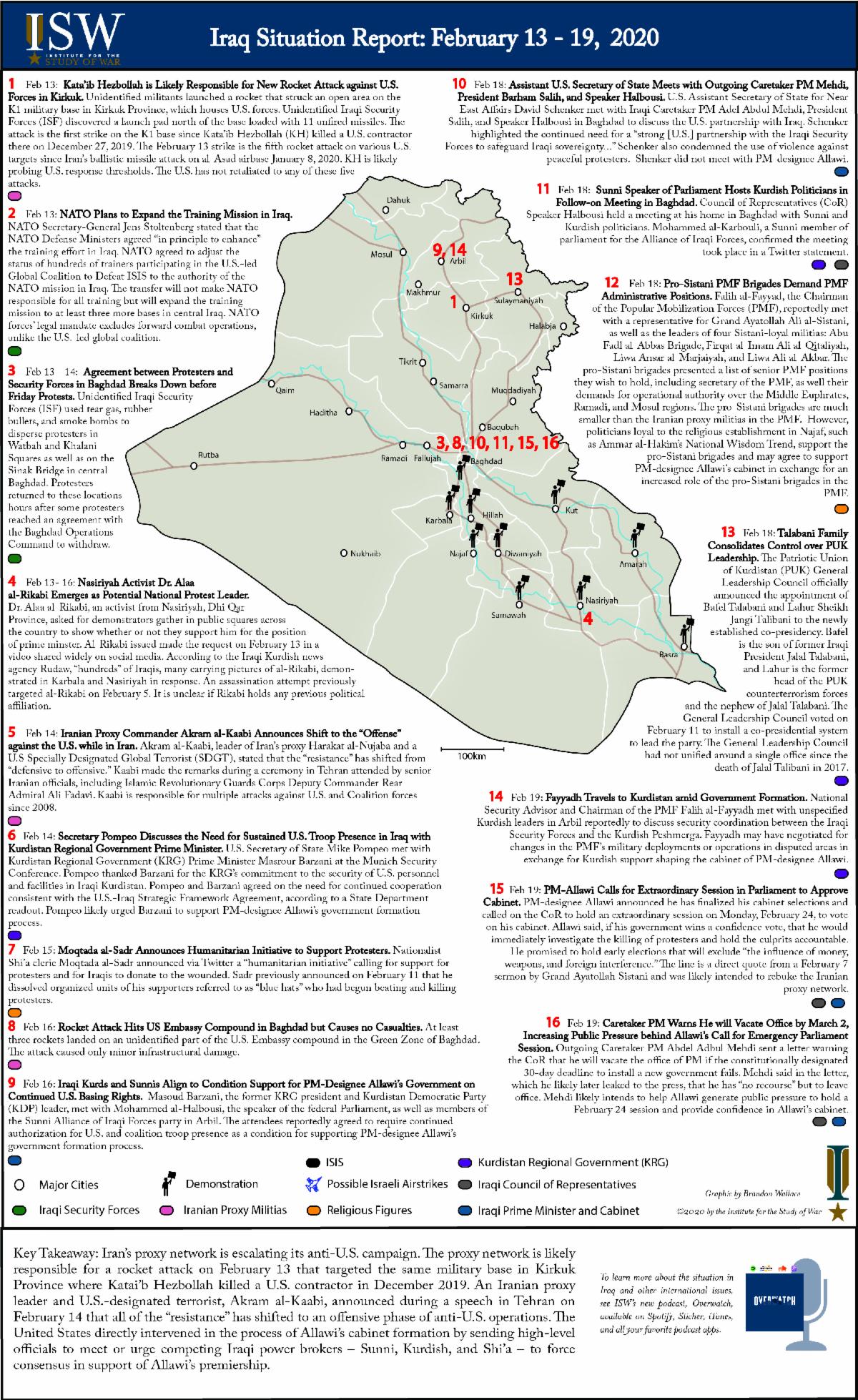
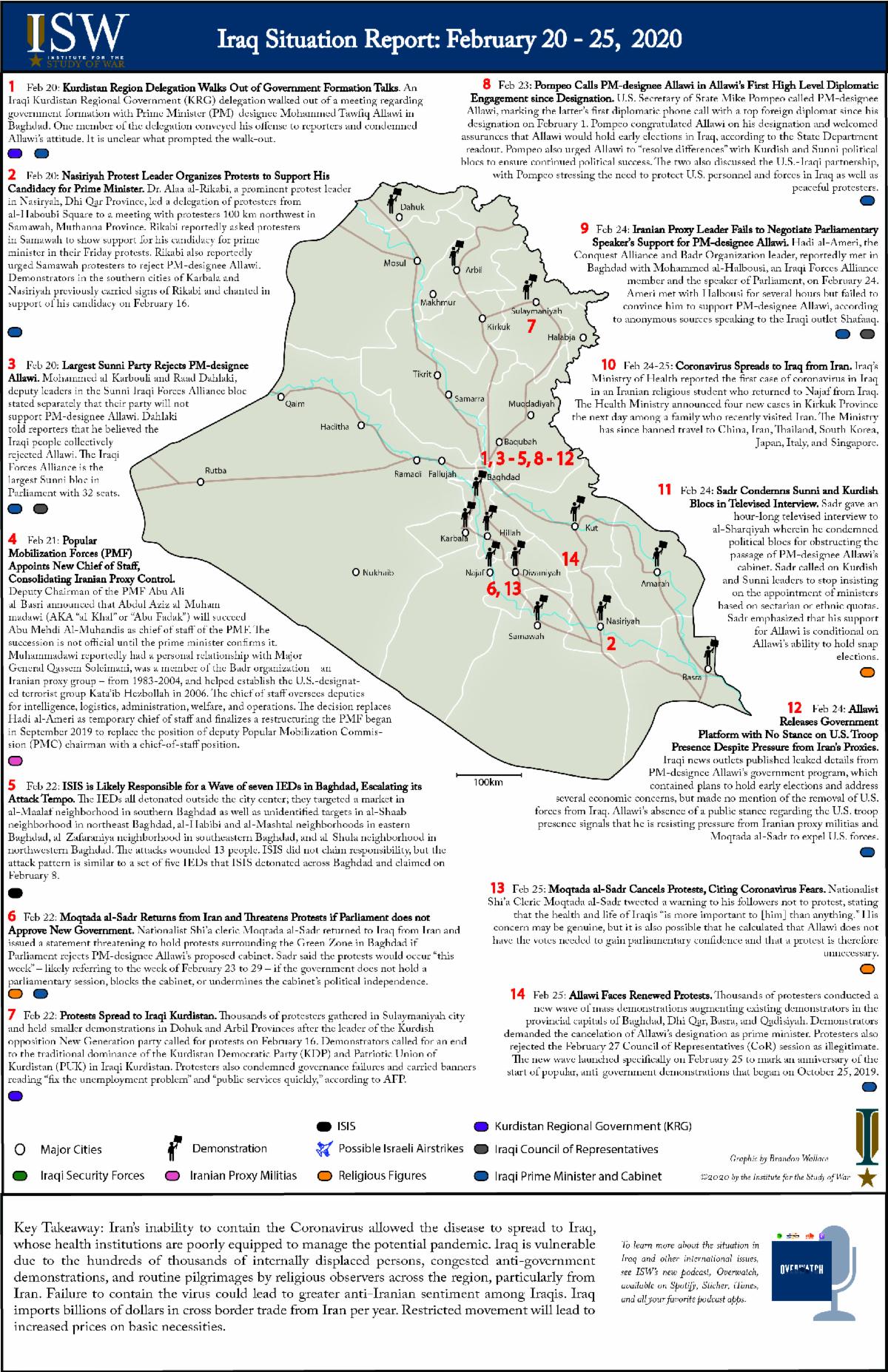
MESOPOTAMIA NEWS : Iraq Situation Reports:February 13 – 25, 2020 BY Institute for the Study of War

ISW is assessing the ongoing unrest and its effects on political-security dynamics in Iraq. The Iraq Situation Report (SITREP) map series summarizes key events and likely developments to come. The following set of SITREP maps covers the period February 13 – 25, 2020.
Key Takeaway: Iran’s proxy network is escalating its anti-U.S. campaign. The proxy network is likely responsible for a rocket attack on February 13 that targeted the same military base in Kirkuk Province where Katai’b Hezbollah killed a U.S. contractor in December 2019. An Iranian proxy leader and U.S.-designated terrorist, Akram al-Kaabi, announced during a speech in Tehran on February 14 that all of the “resistance” has shifted to an offensive phase of anti-U.S. operations. The United States directly intervened in the process of Allawi’s cabinet formation by sending high-level officials to meet or urge competing Iraqi power brokers – Sunni, Kurdish, and Shi’a – to force consensus in support of Allawi’s premiership.
Key Takeaway: Iran’s inability to contain the Coronavirus allowed the disease to spread to Iraq, whose health institutions are poorly equipped to manage the potential pandemic. Iraq is vulnerable due to the hundreds of thousands of internally displaced persons, congested anti-government demonstrations, and routine pilgrimages by religious observers across the region, particularly from Iran. Failure to contain the virus could lead to greater anti-Iranian sentiment among Iraqis. Iraq imports billions of dollars in cross border trade from Iran per year. Restricted movement will lead to increased prices on basic necessities.

« neuere Artikel / next articles   ältere Artikel / previous articles »