MESOPOTAMIA NEWS TAGE DER COMMUNE ! – Der populistische Geist der Pariser Kommune
Vor einhundertfünfzig Jahren interessierten sich Revolutionäre mehr für Demokratie als für Feminismus und Marx.. Ihr Ziel war Freiheit und Emanzipation
Professor Robert Tombs ist Fellow des St John es College, Cambridge, und Autor von The English and Their History 20. März 2021 UNHERD MAGAZINE
Als ich Student in Paris war, verbrachte ich jeden 18. März damit, durch die Straßen von Montmartre zu laufen, wo die Pariser Kommune geboren wurde. Ich würde die Seitenstraße im Osten von Paris besuchen, wo die letzte Barrikade fiel, die Mur des Fédérés, gegen die Kommunarin-Häftlinge hingerichtet wurden, sowie die Steine in den Luxemburger Gärten, die von den Kugeln der Erschießungskommandos ausgespielt wurden.
Sentimental, ich weiß. Ich denke, was mich bewegend fand, war, dass die Kommunarden, einschließlich der meisten ihrer Führer, gewöhnliche Menschen in einer außergewöhnlichen Situation waren. Hier war eine Krise nicht ihrer Herstellung oder Wahl, aber eine, die sie dennoch ergriffen.
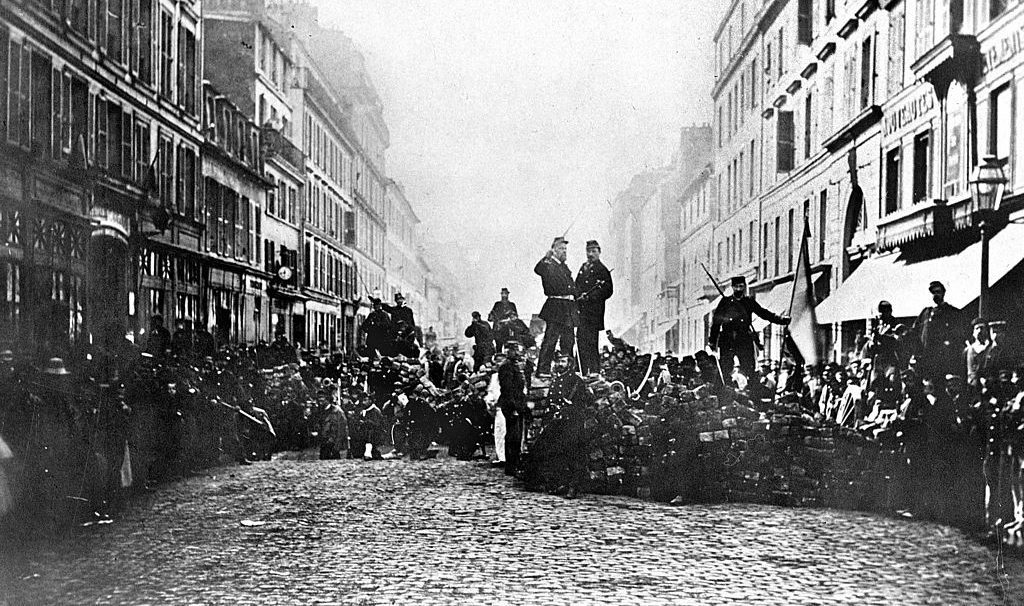
Am 18. März vor 150 Jahren schickte die französische Regierung Truppen, um eine große Anzahl von Kanonen im Besitz der Pariser Nationalgarde, der Bürgermiliz, zurückzuerobern. Massen von Parisern stellten sich heraus, um die Truppen zu stoppen, und in Panik flohen die Regierung, die Armee, die Polizei und der ranghohe zivile Dienst. Paris wurde in den Händen seines Volkes gelassen.
Eine Woche später wählten sie einen Stadtrat, den Conseil de la Commune. Bald darauf kam es in den Vororten zu Zusammenstößen mit Regierungstruppen, die sich in den folgenden sechs Wochen intensivierten. Am 21. Mai kletterten Soldaten über die Stadtmauern, und es folgte eine Woche der Kämpfe, die ganze Straßen in Trümmern, große öffentliche Gebäude in Flammen und die mit Leichen übersäten Straßen hinterließen. Viele hundert Menschen wurden summarisch hingerichtet, 40.000 wurden als Gefangene wegmarschiert und über 4.000 wurden anschließend in Straflager in Neukaledonien verbannt. Die Pariser Kommune schien völlig besiegt.
Dass die Kommune und die “Kommunarden” noch in Erinnerung bleiben sollten, ist, so vage sie auch sein mögen, selbst ein Rätsel. In Europa des 19. Jahrhunderts mangelte es nicht an städtischen Aufständen und blutigen Massakern. Aber nur Fachleute erinnern an den Warschauer Aufstand von 1830, die Revolten in Wien und Prag 1848 oder die Römische Republik 1849.
Ein Teil des Grundes muss sein, dass es Paris betrifft. Aber abgesehen von Delacroix’ Gemälde von Liberty Leading the People und Les Misérableswissen die meisten nichts von den halben Dutzend anderer Pariser Aufstände des Jahrhunderts. Marx schrieb viel über die Kommune, die ein weiterer Teil des Grundes sein muss. Aber dann schrieb er viel über die Revolte vom Juni 1848 und den Staatsstreich vom Dezember 1851,ohne dass dies ausreichte, um sie in die populäre Folklore zu stellen. Ist es also der Name “Kommune”, der sowohl mit Hippie-Träumen von anarchischem Miteinander als auch mit kommunistischen Geschichtserzählungen schwingt?
Für Marxisten (obwohl Marx privat unsicher war) war die Kommune ein politischer und theoretischer Durchbruch: “die Form, die endlich entdeckt wurde”, schrieb er, “für die Emanzipation der Arbeiterklasse”. Die Kommunarden, so argumentierte er, hätten auf eine nicht-unterdrückende und doch völlig revolutionäre Art der Machtausübung getroffen, indem sie alle repressiven Institutionen – Armee, Kirche, Polizei – abgeschafft und die Macht direkt dem Volk selbst übertragen hätten.
Die Marxisten hielten es für selbstverständlich, daß das Industrieproletariat von Paris das dynamischste und zukunftsweisendste Element gewesen sein muss. Engels führte weiter aus, indem er die Kommune als erste “Diktatur des Proletariats” definierte, den Übergang zu einer klassenlosen Gesellschaft. Lenin (dessen Leichnam in eine Kommunarflagge gehüllt werden sollte) war kritischer: Es war die Niederlage der Kommune, die wirklich bedeutsam war. Sie war gescheitert, weil sie nicht die Führung einer disziplinierten Partei hatte und weil sie nicht rücksichtslos genug war, um Klassenfeinde zu bekämpfen. So wurden die Kommunarden im Nachhinein fast ein Jahrhundert lang als Pioniere auf dem langen Marsch zum Kommunismus eingeschrieben.
But a heretical counter-explanation emerged in the 1960s in the work of a young French historian, Jacques Rougerie: the Commune was not the first of a new kind of revolution, he said, but the last of an old one. Rougerie was brutally attacked by the Communist Party for his suggestion that the Communards were the descendants of the sans-culottes of the 1790s. Not an industrial proletariat, but skilled workers in traditional industries (engravers, joiners, cobblers), small businessmen, shopkeepers, clerks. Not looking forwards to Communism, but backwards to self-managed workers’ cooperatives and the republics of 1848 and 1792: they officially adopted the revolutionary calendar, which placed them in the Year 79. So, concluded some historians, the Commune was really the last gasp of the French Revolution.
But historians have a weakness for pioneering movements, which after all give their research projects extra glamour. A popular view in the Swinging Sixties was that the Commune was a bit like May 1968, a carnival of anarchy, even a “total revolution, as one historian suggested fancifully. Or was it a revolution to take back control of space that had been appropriated by bourgeois urbanism?
Particularly in the United States, it was reinvented as an act of feminism. It was the women of the Commune, the notorious pétroleuses, who made it unique. This had once been a label of shame for the (mythical) women who supposedly went round setting fire to buildings. Now it became a title of honour. Communard women not only spoke up for themselves and their collective interests, it was argued, they actually fought on the barricades.
For some American historians, it was their organised use of violence that was the significant novelty of 1871: emancipation by the gun. The most recent reinterpretation is that the Commune was an event in global history, the most fashionable historiographical trend.
Old? New? Leninist? Anarchist? Feminist? Urban? Global? There are plenty of reasons for commemorating its 150th anniversary. But there are also simpler explanations for why the Commune is still remembered by many as inspiring and meaningful.
First is that it was short: two months. As Marx noted, this was only enough to indicate what might have been — and, of course, that includes almost anything. So it is easy to project things onto the Commune, things we would like to imagine as possible. And it also means that it didn’t have time to go really wrong. Yes, there were plenty of errors and some sinister aspects, but compared with the 1793 Terror or Stalinism, the Commune was innocent. It didn’t have time either to moderate into bourgeois banality, or to start devouring its own children. So always unfulfilled, its promise undiminished, it remains (in the words of a famous song written by one of its leaders) “le temps des cerises” — the cherry time.
The other reason it is remembered, as Marx also noted at the time, is because of the ferocity with which it was crushed during the last lurid “Bloody Week” of barricade fighting amid a city in flames. Around 7,000 people were killed — a unique bloodbath for the 19th century. This turned its followers into martyrs, and created a heroic legend.
There is still an annual pilgrimage to one of the killing sites, the Mur des Fédérés in the Père Lachaise cemetery. But the intention was commemoration, not repetition: in future, the French Left would fight at the ballot box, not on the barricade. Quite a number of prominent Communards returned as elected politicians or city officials. Two lived to be ministers in the French national unity government of 1914. Put all these elements together, and you get a powerful if enigmatic memory which can serve a range of purposes, including sentimental nostalgia.
But is this all the Commune can tell us 150 years later? I think there is something else, something that is not so often celebrated: namely, that the Commune was fundamentally about popular democracy. Today, we might even call it “populist”.
France since the implosion of the Revolution in the mid-1790s had lived under a succession of oligarchies, whether under republics, emperors or kings: a roundabout of elites. But the defeat by Germany in 1870-71 had discredited both mainstream Left and Right, and created a political vacuum. It looked as though this would end in another period of monarchy — rule by another section of the elite, with nothing to offer except repression spiced with paternalism.
But the Communards said no: this time the people themselves would rule. Of course, their defeat in war marked a far more dramatic break than anything we have so far experienced in the West. But today’s impatience with politicians, technocratic bureaucracies and establishment “experts” certainly invites some comparisons. Certainly, too many progressives today seem to prefer the elite: they have abandoned the idea that people who are poor, or even those who do ordinary jobs or who have not been to university, have ideas and experience of their own, and an equal right to a political voice.
Populism is feared and denigrated as reactionary. Yet the most basic principle of the Communards was that power should be shared as equally as possible, and that every person (well, every man) had an equal right to make decisions. Office holders at every level would be elected, and if they failed in their duty their electors would dismiss them: not just politicians but officials and magistrates, too. Wherever possible, citizens would perform public duties themselves — for example, as members of the National Guard, they would be their own police force. The aim was freedom and emancipation: to be treated as adults.
This was the purpose behind the secularisation of schools and a widespread demand for technical education: so that, wrote a Communard newspaper, “those who can handle tools can also write books”. It lay behind the aspiration to workers’ cooperatives for women and men. The multiplication of political clubs across the city showed a thirst among ordinary people to have their say on political and social matters, often speaking for the first time in public.
The pithiest expression of the Communard spirit is the famous Internationale, written by a member of the Commune, Eugène Pottier. It includes this: “there are no supreme saviours, not God, not emperors, not politicians … let’s save ourselves; … enough of languishing as dependents, equality demands other laws.”
It is, of course, easy to pick holes in this. Not much was put into practice in seven weeks of civil war, and if it had been it wouldn’t have worked for long: what normal person wants to spend all their evenings in political meetings, sitting on local committees, or patrolling the streets in National Guard uniform chasing prostitutes and bakers illegally working at night (two of the Commune’s slightly eccentric reforms)? Besides, there were plenty of Communards who were a bit too keen on repressing opinions they didn’t like, persecuting harmless priests and nuns, and dreaming of a return to the Jacobin Terror.
Nevertheless, the Communard leadership were reluctant to introduce censorship, disliked locking people up and refused to use the death penalty: the guillotine was fetched from its shed and publicly burnt. Yes, in the end a number of hostages were killed, some even nastily lynched: mainly gendarmes and priests, including the Archbishop of Paris. But this was done in the last desperate days, as Communard prisoners were being slaughtered by the army, and it was never officially sanctioned. As the writer and Commune member Jules Vallès put it, even in defeat they wanted to go down in history “unstained by the filth of the abattoir”. How many revolutionary leaders can say the same? Lenin’s conclusion was that they were fools who were defeated because their “excessive magnanimity” held them back from the “implacable extermination” of their class enemies —not a weakness he ever yielded to.
Die Kommune war sowieso zum Scheitern verurteilt. Keine Regierung würde dieses Niveau der Demokratie zulassen. Hätte die französische Armee sie nicht besiegt, hätte die deutsche Armee, die noch außerhalb der Stadt lagerte, dies wahrscheinlich getan. Oder es wäre von selbst zusammengebrochen: Wie eines seiner Mitglieder beklagte, waren sie wirklich nur “ein gesprächig es, kleines Parlament” und sie waren blutende Unterstützung. Wie wir in der Geschichte immer wieder gesehen haben, wollen die meisten Menschen früher oder später (und oft früher als später) in ein normales langweiliges Leben zurückkehren.
Aber wenn die Kommunarden Lenins rückblickenden Rat vorausgesehen hätten oder dem Beispiel von Robespierres Terror gefolgt wären, hätte die Kommune nicht das rätselhafte, aber positive Vermächtnis hinterlassen, das sie hat – dieses wehmütige, stets unerfüllte Streben nach echter Demokratie.
Es bleibt etwas zutiefst Bewegendes in diesem Streben; ich bewegen genug, um meine jährliche Reise nach Montmartre zu machen. Denn im Großen und Ganzen haben die Kommunarden ihr Bestes getan, nach ihren Lichtern, für die Demokratie, für ihre Stadt und für ihre Mitbürger. Es waren Menschen, für die Freiheit, Gleichheit und Brüderlichkeit inspirierender waren als Zensur, Identität und Opferschaft. Zumindest in diesem Sinne schwingen ihre Handlungen auch heute noch mit.