MESOPOTAMIA NEWS LAST ORDERS TO THE WEST – A 3-Pillar Strategy to Deflate China
- By Rauf Baker ISRAEL – BESA Center Perspectives Paper No. 2,031, May 16, 2021
EXECUTIVE SUMMARY: The West is facing an increasing challenge from China. There are several ways to meet that challenge: expanding, restoring, and deepening relations across different regions of the world; taking a revolutionary approach toward Russia; and, most drastically, acting like the Chinese.
In recent years, an “imperialist” economic shift toward China has been crystallizing in parallel with an ideological quake in the West’s vision of itself and role in the world. With Beijing penetrating African markets along with its steady expansion into Asia, its influence over the American and European economies has reached an unprecedented level. The Chinese are seizing the opportunity presented by the American retrogression and the preoccupation of major European powers with the challenges of terrorism and illegal immigration, as well as the COVID-19 crisis. The last of these was spawned by a virus that originated in China but that caused greater destruction, disruption, and distress abroad than at home.
MESOPOTAMIA NEWS QUESTION: The Gaza War Ended, the Hamas Problem Remains
- By Maj. Gen. (res.) Gershon Hacohen – ISRAEL – BESA Center Perspectives Paper No. 2,042, May 21, 2021
EXECUTIVE SUMMARY: Israel’s relations with Hamas in the coming months will be tested first and foremost by the strengthening of its sovereignty in Jerusalem. This makes the risk of a renewed conflagration extremely high.
As the fourth war between Israel and Hamas in a decade draws to a close after ten days of fighting, there is little doubt that the terror organization’s military infrastructure was massively degraded. Yet through unwavering commitment to its Islamist precepts and vision, Hamas managed to divert attention from these losses to its supposed success in defending Islam’s holy shrines in Jerusalem, thus casting itself in the eyes of Muslims throughout the world as the unquestionable winner of the war.
MESOPOTAMIA NEWS SIGNIFICANT ! : Statement on Israel/Palestine by Scholars of Jewish Studies and Israel Studies
| May 2021 | |||
As scholars of Jewish Studies and Israel Studies based in various universities, departments, and disciplines, we condemn the state violence that the Israeli government and its security forces have been carrying out in Gaza; their evictions of Palestinian residents of Sheikh Jarrah and other neighborhoods of East Jerusalem; and their suppression of civilian protests in the West Bank, East Jerusalem, Jewish-Arab cities, and Palestinian towns and villages in Israel. We express profound sadness at the recurrence of intercommunal violence between Jewish and Palestinian citizens of Israel and anger at the impunity enjoyed by most Jewish attackers.
We share and hold the pain of Gazans, who have lost and are losing family members, homes, property, businesses, cultural institutions, medical facilities, and civilian infrastructure to Israeli bombings and of Palestinians in the West Bank who have lost loved ones in shootings by security forces. We affirm the pain, fear, and anger of Israeli Jews and Palestinian citizens of Israel who have lost loved ones and homes to unjustifiable and indiscriminate Hamas rockets.
As such, we stand with our Israeli, Palestinian, American (including Jewish American), and international colleagues who are working towards a process of structural change that would bring equality and justice in Israel/Palestine, a systemically unequal space that, nonetheless and inescapably, has a common history and future. We also denounce expressions of antisemitism or islamophobia in connection with ongoing events in Israel/Palestine.
MESOPOTAMIA NEWS : VON DER OSTEN VIA MORIA NACH WESTEN / DER IMPORTIERTE ZUSÄTZLICHE ANTISEMITISMUS
Import Export : Judenhass ist der Kern aller islamistischen Bewegungen
-
Von Ronya Othmann FAZ – 23.05.2021-08:45
Es ist wieder Nahostkonflikt. Eben waren noch alle Virologen, jetzt sind alle Nahostexperten. Auf Social Media werden fleißig Infografiken geteilt, auch wenn man nicht genau weiß, was der Unterschied zwischen Westbank und Gaza ist. Oder dass die Videos und Posts mitunter von Islamisten kommen, egal – dabei sein ist alles. Auf deutschen Straßen wird wieder „Kindermörder Israel“ gerufen, mit „From the river to the sea Palestine will be free“ ein judenfreies Nahost erträumt. Mal heißt es „Chaibar, Chaibar, ihr Juden, Mohammeds Heer kommt bald wieder“, dann wieder „Bombardiert Tel Aviv“. Querfronten werden gebildet, Islamisten laufen neben antiimperialistischen Linken, neben panarabischen Nationalisten, neben türkischen Rechten. Zu sehen sind auch: Saddam-Hussein-T-Shirts, Symbole der Grauen Wölfe, iranische Flaggen. Mitunter werden diese antisemitischen Aufmärsche auch als Israelkritik oder Dekolonisierung gelabelt. Man fragt sich: Wenn Israelkritik, warum vor Synagogen und nicht vor der israelischen Botschaft?
MESOPOTAMIA NEWS PEACE FINISHED – Acre: A model of Israeli coexistence struggles after racial riots
INTERNAL AFFAIRS: When mosque loudspeakers spread word of what was happening, Arabs took to the streets, vandalizing property. Jews later set fire to two Arab homes and damaged several others. – By MAAYAN JAFFE-HOFFMAN JERUSALEM POST MAY 20, 2021
The streets of the northern coastal town of Acre are already buzzing by 7:30 a.m. In front of Ofer’s coffee shop, five plastic tables are set with shots of espresso in small angled glasses, steaming cups of Turkish coffee and lattes, filled high and frothed with milk.
But around the tables of the store, which has existed for the last 30 years, is a sight rarely witnessed in the State of Israel: Jews, Muslims and Christians are sitting side by side.
MESOPOTAMIA NEWS : DEMONSTRATIONEN NUR NOCH FÜR DAS ERLAUBTE & GENEHME / ORWELLIAN TIMES !
Demos in Berlin: Gericht bestätigt Verbot der “Querdenker”-Proteste
Pfingstwochenende – 22.05.2021, 17:39 | Lesedauer: 7 Minuten – Philipp Siebert MORGENPOST – BERLIN
Bei einer Demonstration von Corona-Leugnern am 18. November 2020 setzte die Berliner Polizei erstmals seit sieben Jahren wieder Wasserwerfer ein.In Berlin sind insgesamt elf Demonstrationen am Wochenende verboten worden. Das Oberverwaltungsgericht sprach nun das letzte Wort.
MESOPOTAMIA NEWS : TOTAL Mapping Gaza: Schools, hospitals, refugee camps and more
Al Jazeera takes you on a tour of key locations across the densely populated Gaza Strip.
Since 2008, Israel has waged four wars on the Palestinian territory, killing thousands of people, mostly civilians. During Israel’s latest offensive on Gaza, Israeli attacks damaged at least 51 education facilities, including 46 schools, two kindergartens, an UNRWA (The United Nations Relief and Works Agency for Palestine Refugees in the Near East) training centre, and parts of the Islamic University of Gaza, according to the United Nations’ latest humanitarian report.
At least 66,000 people are still sheltering in 58 UN-run schools across the Gaza Strip.
Israeli raids also damaged at least six hospitals and 11 primary healthcare centres, including Gaza’s only COVID-19 testing laboratory that was left inoperable following an Israeli attack that hit a nearby building on May 17.
Gaza’s electricity network also suffered damage, leading to 20-21 hours of daily power outages. This has affected water and sanitation facilities across the strip, leaving at least 250,000 people without access to drinking water.
Gaza has a population of about 2.1 million people living in five governorates – North Gaza, Gaza City, Deir al-Balah, Khan Yunis, and Rafah. Bordered by Israel and Egypt on the Mediterranean coast, the strip is about 365 square kilometres (141sq miles) – about the size of Cape Town, Detroit, or Lucknow. At only 41km (25 miles) long, it can take less than an hour to drive from Rafah in the south to Beit Hanoun in the north.
In the following series of maps, Al Jazeera takes you on a journey across Gaza’s five governorates highlighting key locations including hospitals, schools, universities, UN compounds, refugee camps, crossings and other vital infrastructure.
North Gaza
The district of North Gaza shares a 10km-long (six-mile-long) border with Israel. The Gaza Strip is surrounded by a heavily fortified perimeter consisting of a concrete wall and double-wired fencing. Anyone who steps within one kilometre (0.6 miles) of this barrier is in danger of being shot by the Israeli army, which patrols Gaza’s northern and eastern borders.
The Erez crossing, managed by the Israeli army, is Gaza’s only northern crossing into Israel. From there, Palestinians with special permits – usually for urgent medical treatment – are allowed to leave Gaza on their way to Jerusalem or the West Bank. Gaza is only a 100-km (60-mile) drive to Jerusalem but because of tight security measures, this journey can take several hours. Since 2007, Israel has imposed a sea and air blockade of Gaza.
North Gaza is home to the largest refugee camp in the Strip. The Jabalia refugee camp covers an area of 1.4sq km (0.5sq miles), and with a population of 114,000 people is one of the most densely populated places on Earth.

Gaza City
Gaza City is the largest and most populous city within the Gaza Strip, with about 700,000 residents. Rimal, Shujaiya and Tel al-Hawa are among its most well-known neighbourhoods.
At the heart of the Rimal neighbourhood is Al Shifa Hospital – the largest medical facility in the Gaza Strip. Intensive care units there are desperately overcrowded and are “having lots of difficulties in running equipment”, Gaza journalist Youmna al-Sayed reported on Thursday.
Surrounding the hospital are several UN compounds including UNRWA (The United Nations Relief and Works Agency for Palestine Refugees in the Near East), UNSCO (The office of the United Nations Special Coordinator for the Middle East Peace Process) and UNDP (UN Development Programme) compounds. Gaza’s top universities – including the Islamic University of Gaza, Al Azhar University and the Al Aqsa University, which are just a few hundred metres apart – are also located in the Rimal neighbourhood.
The Shati refugee camp, also known as Beach Camp, is located along Gaza’s Mediterranean coastline and is the third-largest out of the Gaza Strip’s eight camps.
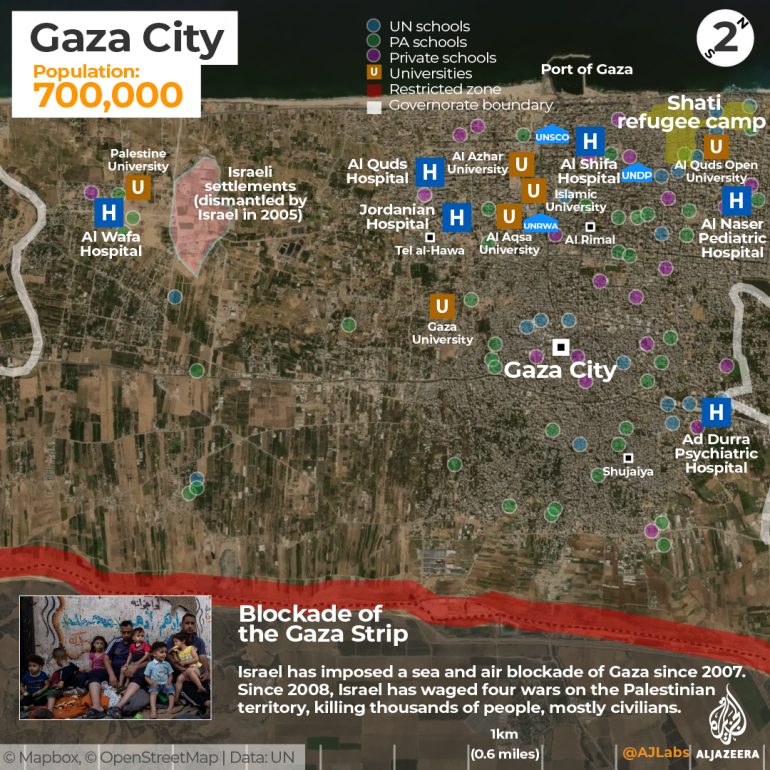
Deir el-Balah
Named after the “Monastery of the Date Palm”, Deir el-Balah is one of Gaza’s largest agricultural producers. It is also home to four refugee camps; Nuseirat, Al Bureij, Al Maghazi and Deir el-Balah.
Gaza’s only operating power plant is located along the district’s boundary with Gaza City. For the past 10 years, the Gaza Strip has suffered from chronic electricity shortages, which have severely affected its ability to provide essential services including health, water and sanitation services, manufacturing and agriculture.
Only 5 percent of Gaza’s water is safe to drink and 68 percent of its population suffer from food insecurity, according to the UN.
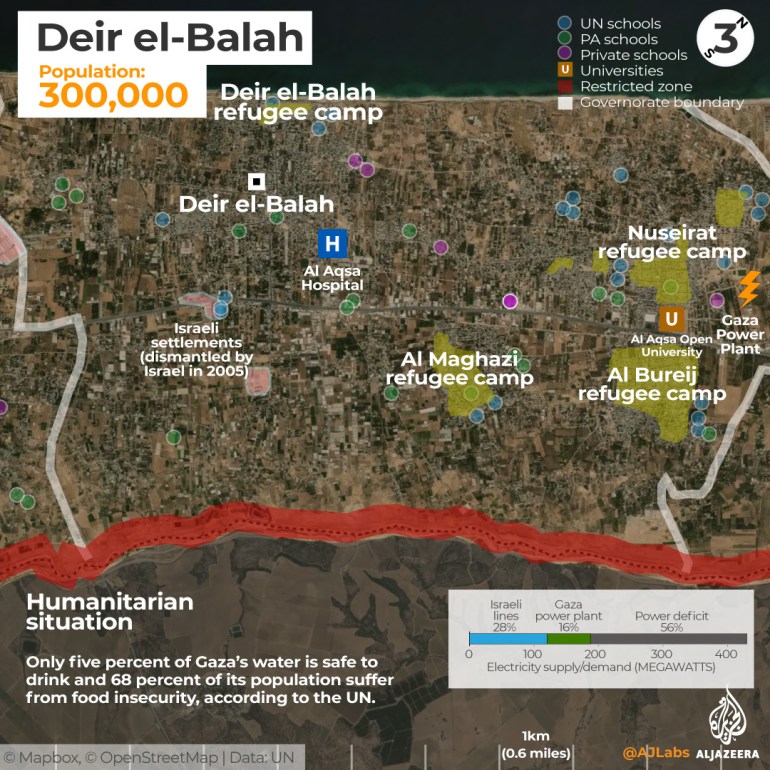
Khan Yunis
The district of Khan Yunis is home to 400,000 people. At its centre is the Khan Yunis refugee camp, home to about 87,000 people.
In 2005, nearly 8,000 Jewish settlers and Israeli troops living in 21 settlements around Gaza were relocated mostly to the occupied West Bank following a decision by then-Israeli Prime Minister Ariel Sharon to unilaterally disengage from the Gaza Strip. Most of these settlements were in Khan Yunis
Israel claimed its occupation of Gaza since 1967 has ended as it has pulled its troops and settlers from the territory but international law views Gaza as occupied territory because Israel has full control over Gaza’s borders, airspace and territorial waters.

Rafah
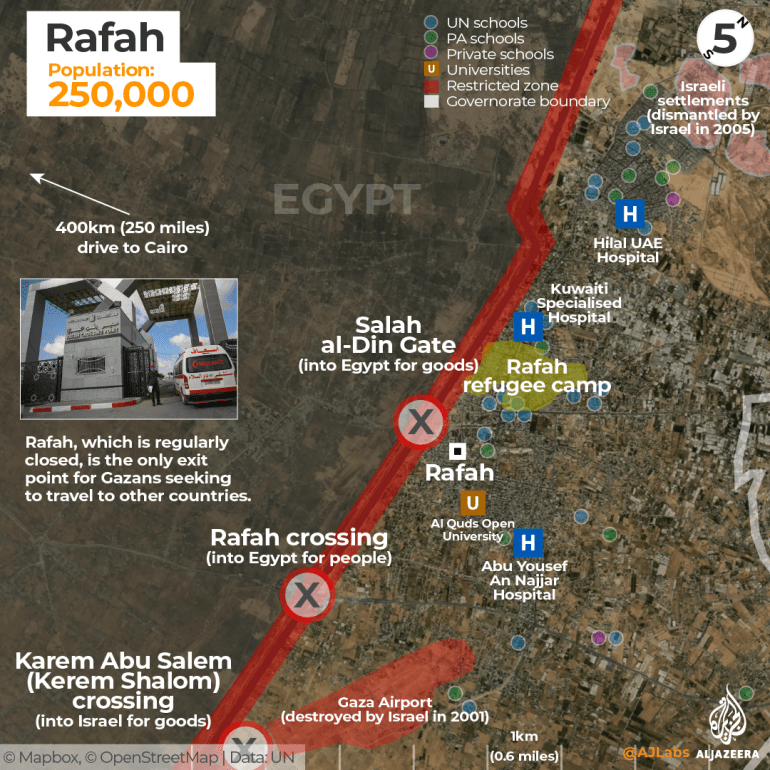
Rafah is the southernmost district of Gaza with a population of 250,000 people. The district is best known for the crossing with Egypt that bears its name.
In 2020, the Rafah crossing and the Erez crossing into Israel were only open for 125 days, according to the UN. Palestinians who wish to leave must apply for a limited number of passes to leave the Gaza Strip. This process may take weeks or months, depending on the status of the border.
Those who are able to get through the Rafah crossing must then make a six-to-eight-hour journey through the Sinai Desert passing several Egyptian checkpoints on their way to Cairo, 400km (250 miles) away. Rafah’s second crossing into Egypt is the Salah al-Din gate used for transporting goods.
The third crossing from Rafah is the Israeli-controlled Karem Abu Salem (Kerem Shalom) crossing. On May 18, it temporarily opened to allow the passage of humanitarian and commercial cargo. However, only five of the 24 permitted trucks were allowed through before it was prematurely closed.
Gaza has no functional airports after Israel bombed and demolished the Yasser Arafat International Airport in 2001, only three years after it opened.
Gaza again is the scene of widespread destruction and human suffering and remains the place often described as “the world’s largest open-air prison”.
MESOPOTAMIA NEWS – Nahostkonflikt : Biden hält Zwei-Staaten-Lösung für „einzige Antwort“
- Aktualisiert am 22.05.2021-03:59 FAZ JOCHEN STAHNKE – Der amerikanische Präsident hält nachhaltigen Frieden im Nahen Osten nur für möglich, wenn alle Akteure Israels Existenzrecht anerkennen. Für die Zusammenstöße in Jerusalem macht er Extremisten auf beiden Seiten verantwortlich.
Der Konflikt zwischen Israelis und Palästinensern kann nach Ansicht des amerikanischen Präsidenten Joe Biden langfristig nur durch eine Zweistaatenlösung befriedet werden. „Das ist die einzige Antwort, die einzige Antwort“, betonte Biden am Freitag im Weißen Haus. Die vereinbarte Waffenruhe biete die Chance, in diese Richtung Fortschritte zu erzielen. Er werde dafür „beten“, dass diese halten werde. Israels Regierungschef Benjamin Netanjahu habe ihm sein Wort gegeben, und dieser habe ihm gegenüber sein Wort nie gebrochen.
MESOPOTAMIA NEWS „WO IST DIE LÖSUNG?“ – Nach der Waffenruhe in Nahost : Zwei Sieger, ein Verlierer
Nach der Waffenruhe in Nahost lassen sich sowohl die Hamas als auch Israel als Gewinner feiern. Palästinenserpräsident Mahmud Abbas geht hingegen deutlich geschwächt aus dem Kurzkrieg hervor.
- Von Jochen Stahnke, Tel Aviv FAZ 21.05.2021-21:37 – Die in der Nacht zum Freitag in Kraft getretene Waffenruhe zwischen der Hamas und Israel hielt schon ein paar Stunden, da gingen in Ramallah Hunderte Menschen auf die Straße, um einen Sieg der Islamisten zu feiern. Eine derartige Kundgebung mit grünen Fahnen der Islamisten hatte es seit mehreren Jahren nicht mehr in Ramallah gegeben, dem Sitz der palästinensischen Autonomiebehörde und der dort regierenden Partei Fatah. Deren Präsident Mahmud Abbas ist ein Gegner der Hamas, und seine Sicherheitskräfte hatten gemeinsam mit israelischen Kräften in den vergangenen Wochen einige Funktionäre der Hamas festgenommen. Doch diesmal griff die Polizei der Autonomiebehörde nicht ein. Sie wollte keine Zusammenstöße provozieren und der unbeliebte Abbas nicht noch weiteren Volkszorn auf sich lenken.
MESOPOTAMIA NEWS : Turkey manufacturing water crisis to pressure Damascus and Syria’s Kurds
By Paul Antonopoulos, independent geopolitical analyst – 20 May 2021
Turkey has reduced the flow of the Euphrates River from 500 m3 per second to less than 200 m3 per second. This will have a major consequence on Syria – a threat of drought with summer only around the corner. Ankara is effectively weaponizing water to pressure Damascus and Kurdish-held cities.
Syrians have noticed a major drop in the river’s level, almost a total of five meters in some places. Osama Khalaf, spokesman for the Raqqa municipal council, explained that “fishery is affected and the health consequences are starting to be felt. Desertification is progressing. This is a deliberate strategy on Turkey’s part.”
« neuere Artikel / next articles ältere Artikel / previous articles »