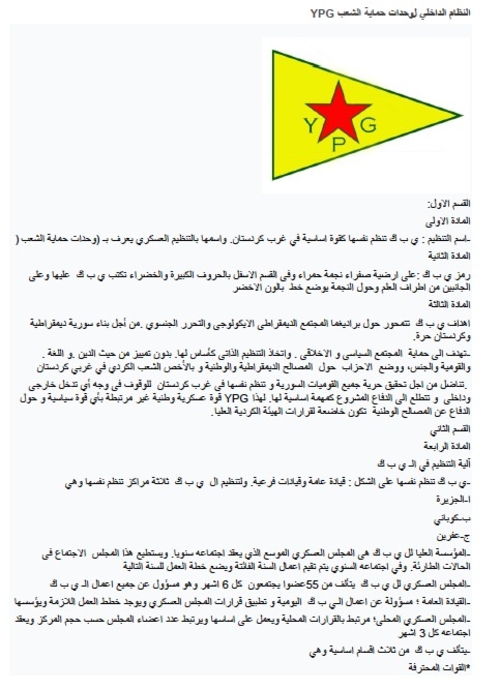
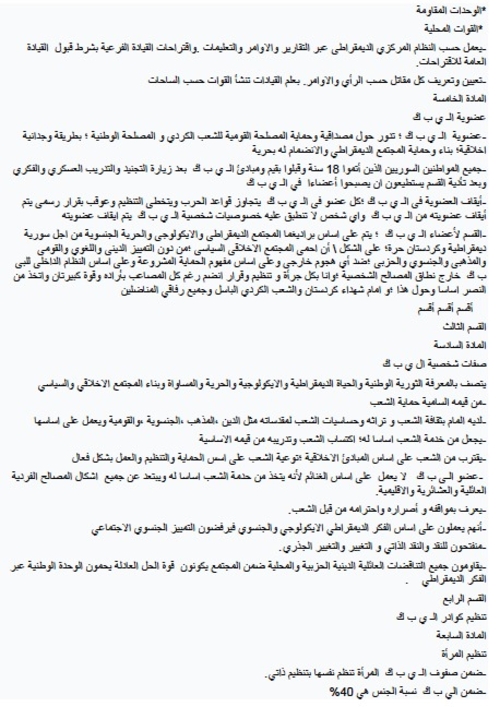
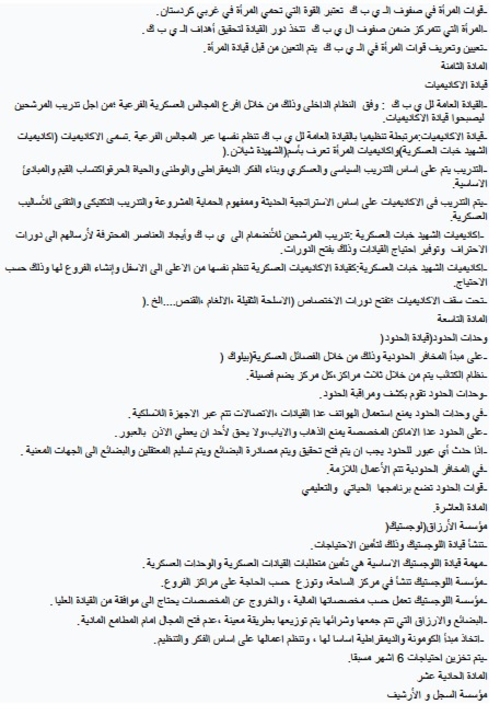
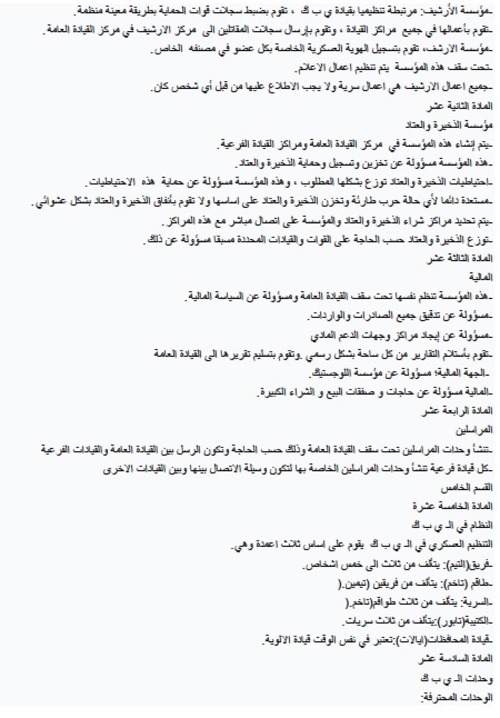
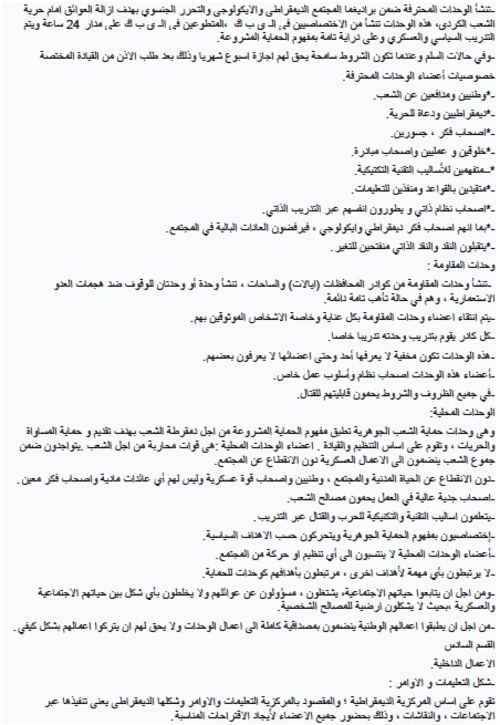
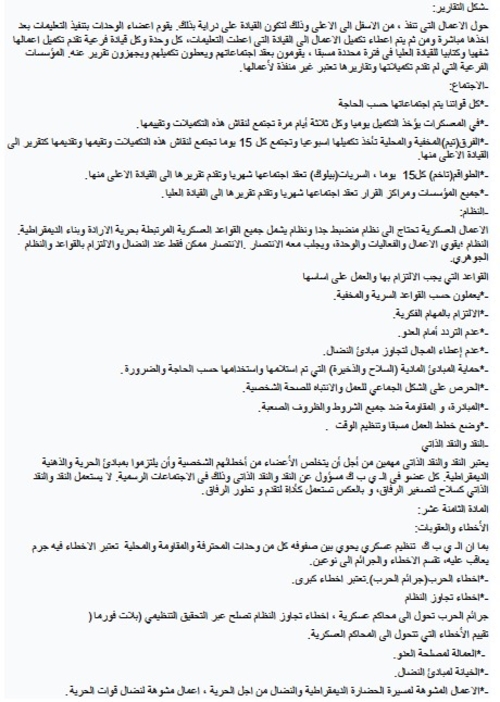
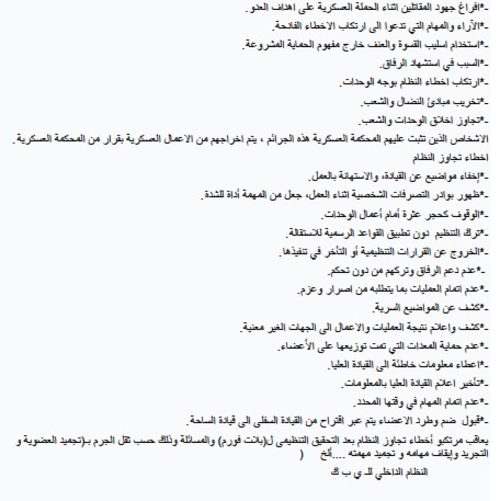
Previously I have covered old documents dealing with the internal systems of the YPG and the YPJ, which are foundational components of the U.S.-backed Syrian Democratic Forces (SDF). Those old documents predated the establishment of the SDF. In contrast, the document translated in this post concerns the internal system of the SDF. This document was published online by the SDF Press website this year and covers various aspects of the SDF such as the broad outline of the internal structure, the SDF’s institutions and the system of documenting reports and holding meetings. The document also covers mechanisms of appointments, promotions, expulsions, disciplinary actions and so on.
The SDF internal system acknowledges seven foundational components of the SDF:
. YPG
. YPJ
. Syriac Military Council
. Sanadid Forces
. Jaysh al-Thuwar
. Liwa al-Shamal al-Dimoqrati
. Jabhat al-Akrad
The SDF also arranges itself in the following order of general military bodies from highest to lowest in authority:
. General Congress of the Military Councils
. General Command
. Supreme Military Council
. The Expanded Military Council
Geographically, the SDF divides its forces into five regional commands. These five regions (manatiq) are in turn divided into sectors (qita’at). The five regions are:
. al-Jazeera region (i.e. Hasakah)
. Euphrates region (i.e. Kobani, Raqqa and Manbij areas)
. Western region (i.e. Afrin and Aleppo areas)
. Eastern region (i.e. Deir az-Zor)
. Idlib region
There are also four forces commands. They are:
. Self-Defence Obligation (combination of conscripts and volunteers).
. Commandoes
. Counter-Terrorism Forces
. Grouping of the Combat Brigades
At the level of the regions, there are the Military Councils of the Regions (e.g. the Military Council of Deir az-Zor) and their expanded forms. In addition, at the sector level, one has the Military Councils of the Sectors (e.g. the Military Council of Hajin within the Deir az-Zor/eastern region) and their expanded forms.
Finally note the smaller unit groupings within the SDF forces:
. Brigades (alwiya). Their command is appointed by the regional command.
. Squadrons (saraya) and Battalions (kata’ib). Their command is appointed by the brigades command.
. Regiments (afwaj). Their command is appointed by the sector command.
. Contingents (majmu’at) and Factions (fasa’il). Their command is appointed by the regiments command.
Below is the document translated in full.
———————————————
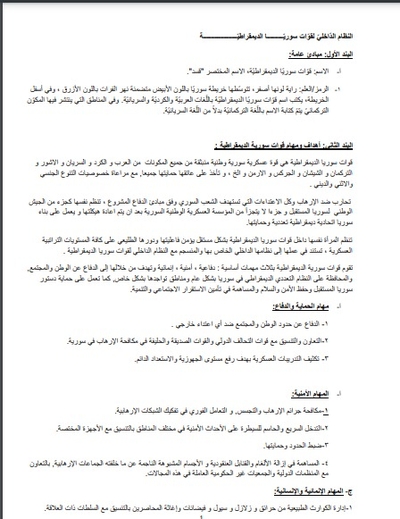
The Internal System of the Syrian Democratic Forces
Article One: General Principles
a) Name: Syrian Democratic Forces. Abbreviation: SDF.
b) Symbol/Flag: yellow flag, in the middle of which is a map of Syria in white including the Euphrates River in blue, and at the bottom of the map is written the name of Syrian Democratic Forces in the Arabic, Kurdish and Syriac languages. And in the areas in which the Turkmen component is spread, the name is to be written in the Turkmen language instead of the Syriac language.
Article Two: Aims and Missions of the Syrian Democratic Forces
The Syrian Democratic Forces is a national Syrian military force derived from all of the components of the Arabs, Kurds, Syriacs, Assyrians, Turkmen, Chechens, Circassians and Armenians etc., and it adopts on its shoulder the protection of all of them, while observing the particulars of gender, ethnic and religious diversity.
It combats terrorism and all attacks that target the Syrian people in accordance with the principles of legitimate defence, organising itself as a part of the national army for the future Syria and an indivisible part of the Syrian national military institution after it is reformed and there is work on building a pluralistic, democratic, federal Syria and its protection.
The woman organises herself inside the Syrian Democratic Forces in an independent sense that secures her activity and vanguard role on all military organisational levels, relying in her work on her own internal system and in keeping with the internal system of the Syrian Democratic Forces.
The Syrian Democratic forces undertake three fundamental missions: defence, security and advancement. And it aims through them to defend the homeland and the society, and preserve the pluralistic democratic system in Syria in a general sense and the areas of its presence in particular. It also works to protect the constitution of the future Syria and preserve the security and peace and participating in securing the social stability and development.
a) Assignments of the protection and defence:
1. Defending the borders of the homeland and society against any external attack.
2. Cooperation and coordination with the international coalition forces and the friendly and allied forces in combating terrorism in Syria.
3. Intensifying the military trainings with the aim of raising the level of readiness and constant preparation.
b) Security missions:
1. Combating terrorism crimes and espionage, and immediately working in dismantling the terrorist networks.
2. Rapid and decisive intervention to control the security incidents in the various areas in coordination with the relevant apparatuses.
3. Controlling and protecting the borders.
4. Participating in removing the mines and cluster munitions and suspect bodies deriving from what the terrorist groups have left behind, in cooperation with the international organisations and NGOs working in these fields.
c) Development and Humanitarian Missions:
1. Managing national disasters from fires, earthquakes, floods and deluges and providing relief for besieged people in coordination with the relevant authorities.
2. Offering various aid in the disaster zones and aiding the schools, hospitals and civil institutions in the framework of programs of military-civil cooperation.
3. Active participation in restoring stability and renovating the lands to rebuild and restore stability in the areas damaged by terrorism.
Article Three: Means of Work of the Syrian Democratic Forces
The Syrian Democratic Forces relies on an official central system disciplined in force that is considered the central apparatus for all the sectors of the military formations in accordance with the needs and requirements. In the event of every deficiency in any level in these mechanisms, whatever their type, and without unconditional fundamental compliance with these mechanisms, it is not possible to speak about any success or victory in any military formations, because they constitute the essence of the military force and push them to work in mutual coordination through which victory is preserved and that is in accordance with the system of commands, instructions, reports and meetings.
a) Commands and Instructions:
1. They are all that is issued from the higher official to those under his leadership, that must be implemented exactly and with termination and initiative without hesitation, grumbling or discussion.
2. All instructions are important and must be implemented, and one cannot divide the commands and instructions into assignment and unimportant.
3. The ethical concept relies on the principle of the unity of instructions.
4. The commander must keep away from moodiness in the issuing of the instructions.
5. One must keep away from selectiveness in issuing instructions or implementing them.
6. Implementation of the instructions is part of the military discipline in the military unit.
7. Not implementing instructions or any deficiency in them will expose the one responsible for that to accountability.
b) Reports:
They are the response that the one under leadership submits and who has received the instructions and commands concerning the level of his implementation and carrying out of his assignments.
1. Reports in writing only, or orally in an official meeting session that has a written meeting form.
2. It is now allowed to use the report as a justification for not carrying out the assignment well.
3. The report must include the opinion of its owner and his suggestions and alternative he considers appropriate to develop the military process as a whole.
c) Meetings:
Meaning regular and emergency meetings, and they are considered one of the main means to express democracy inside the military institution just as they are a specialised process distinguishing between two stages that differ in implementation and success.
1. Opening the field before all to express their opinion in all matters put forward in the meeting and offering suggestions and solutions.
2. Every decision agreed in the meeting is to be put forward as a suggestion to the commission higher than it and there is to be no implementation until after it agrees to it.
3. Reports of meetings are to be recorded in writing and in detail and in clear handwriting as these are considered official archives and they are to be archived.
4. Defining a specific system for meetings is to occur in accordance with a specific and appropriate timetable.
Article Four
Military Discipline: discipline is considered one of the fundamental phenomena of military life and a distinguishing sign concerning earnestness and compliance and engagement in that it shows the extent of respect and goodness of conduct and implementation of the commands to the letter and their spirit with wholesale satisfaction without any hesitation or grumbling, and military discipline relies on the following foundations and components:
1. Correct understanding of the concept of the military doctrine.
2. Love of the homeland and sacrifice in the path of defending it.
3. Mutual trust between the commander and subordinates and development and exchange of respect in what is between them.
4. Continual training on order and military connection and compliance with the instructions with complete contentment.
5. Developing the directive of knowledge and familiarity and ability to innovate.
6. Defining the responsibilities is among the most important components of discipline, with observation of the individual differences on classifying the individuals and defining the responsibilities in what accords with the ability and capabilities of the members.
7. The leaders must represent the good example on all levels.
8. Every member must behave uprightly inside and outside the barracks and camps.
9. The fighters and commanders must comply with the good display and military dress and respect the honour of affiliation with the military institution.
10. Competency in carrying out the obligations and missions with high zeal and in a form that arises on pride and zeal.
11. The personnel are to respect their commanders and colleagues and spread the spirit of affection in dealing with them while keeping away from all the forms of family, tribal, religious and ethnic relations and not languishing in them.
12. Preserving the readiness of the weapons and equipment and considering them an indivisible part of one’s military honour.
13. Personnel and fighters are to comply with the military traditions and keep away from behaviour and conduct and customs of civilians, while implanting work with team spirit constantly.
14. Holding to account the one who commits the error is a necessity that cannot be neglected in order to limit the negative consequence and deviation inside the military institution.
4. Secrecy: secrecy is considered one of the foundational principles upon which the success or failure of any military operation depend. Therefore, divulging any secret is one of the great crimes that are punished in all the international military laws.
Article Five: Principles of Work in the Syrian Democratic Forces:
a) Legitimate defence:
1. Legitimate defence is a right established by all laws and legislations and international and humanitarian customs when the people or homeland or their fundamental values are exposed to any hostile attacks targeting them, and it is a comprehensive process dealing with the circumstances and developments through strategies and tactics connected with the circumstances and capabilities.
2. Reliance on the principles of legitimate defence and this means compliance with the fundamental principle embodied in clinging to defence against all attacks through mobilisation of all capabilities, including active positive defence with the consideration that that does not mean ruling out reserve defences through attack on need.
3. Protecting the people and its existence and its fundamental values when exposed to attack and the consideration of that as a call to comprehensive defence and mobilising all the possible forces.
4. Protecting the wealth and private possessions of the people, is a legitimate right established by all the religions, constitutions and democratic customs and this principle is to be applied in times of war and peace also and therefore any transgression or violation of this principle will be held accountable.
b) Collective spirit:
it is one of the fundamental standards for organised and precise work, therefore the most exemplary and productive employment of it is necessary through mobilising all the available forces with the group for the best securing of capabilities to realise victory.
a) The collectiveness does not mean random and disorganised mobilisation but rather means mobilising that is goal-oriented and organised on the highest levels in the framework of division of missions.
c) Respect:
1. It is a group of principles and foundations directed to man towards outlined aims with respect of the fundamental values of life, and they constitute a self-restraint for compliance with the bases of the work of fighting so respect and assessment of work and individual and collective hard-work are a clear standard for military regulations and laws and respect of the society and its material and spiritual values.
2. All that the revolution has produced materially and spiritually constitutes the values of the revolution that cannot be separated but rather constitute a comprehensive unity that carries between its wings an ethical nobility embodied in respecting the efforts and deeds that have been expended for the sake of it, including martyrdom as the most precious of values.
3. One must save the wounded and martyrs from the fields of combat and any neglect or shortcoming in that, in so far as it is considered a violation of ethics, will expose the one who commits it to accountability.
4. Prisoners are to be dealt with in accordance with the international laws, treaties and conventions.
5. One must respect the work of the civilian institutions that operate in parallel with the military units that undertake their obligation on the fronts, and one must offer all the facilitations so they can undertake their work.
6. According to the principles upon which these forces have been established as the force that bears and guarantees the co-existence between all the components, the racist, ethnic chauvinist, sectarian, madhhabist and other concepts that infringe on the society and harms its unity is rejected, and this will expose those who commit and promote these things and tolerate them to severe punishments.
7. Compliance with the national interest and protecting the social fabric far removed from inclination towards ethnic chauvinist, religious chauvinist and madhhabist concept.
8. Any infringement on these values and principles constitutes betrayal of the free society.
d) Partnership:
As it guarantees high coordination between the leaderships of the forces presence in the same fronts and areas and likewise it guarantees participation of all the components of the Syrian people without discrimination in the administrative and leadership institutions of the Syrian Democratic Forces.
Article Six: Conditions of Membership
a) The condition of the acceptance of the membership of every fighter within the Syrian Democratic Forces is that the fighter should be over the age of 18 years and be subject to the foundational ‘SDF’ course.
1. Joining of the Syrian Democratic Forces is to be accepted on a voluntary basis, through a work contract or through service within the Self-Defence Obligation.
2. In accordance with the implementation of the clauses of the internal system, members of the ‘SDF’ are not to be released except by decision from the relevant authorities.
3. No fighter in the SDF regardless of his rank has the right to be cut off from his work in the SDF formations without submitting an official resignation request to the general command provided that it includes convincing reasons that necessitate resignation.
Article Seven: Organisational Framework of the Syrian Democratic Forces
The Syrian Democratic Forces organise themselves from highest to lowest.
1. General Congress of the Military Councils: convenes once every year and takes into account the internal system, and designs the military strategy and military institution system to establish the necessary changes and yearly plans.
2. General Command:
a) Composed of the General Commander and his assistants and the representatives of the foundational components of the SDF (People’s Protection Units, Woman’s Protection Units, the Syriac Military Council, the Sanadid Forces, Jaysh al-Thuwar, Liwa al-Shamal al-Dimoqrati and Jabhat al-Akrad) and two representatives from the military councils, and they are to be appointed during the annual congress of the military councils and connected with the General Command is the advisory office that coordinates its relations with the institutions of the Autonomous Administration and the political and social organisations. And likewise connected with it is the coordination centre and the military operations that coordinate their work with the friendly forces.
b) Obligations and missions of the General Command:
1. Preparing and training the forces for the missions entrusted to them, in physical and thought terms.
2. Raising the combat level of the forces.
3. Leadership of the military operations in planning and implementation.
4. Organising the sectors and units and defining their missions and administration.
5. Implementing the operations of alertness and mobilisation on their announcement.
6. Organising the offices connected with it and directing their activities.
7. Preparing the plans and combat commands and supplementing the needs of the forces and preserving the level of preparations and equipment.
8. Putting in place the logistic programs for the forces and tracking their implementation.
9. Managing the regular meetings of the military council and invitation to exceptional meetings when needed.
10. Establishing new commissions or offices or committees according to need or dissolving them.
11. Organising the work of the Supreme Military Court and certifying its decisions or rejecting them or modifying them.
12. Appointing the male/female spokesperson in the name of the Syrian Democratic Forces.
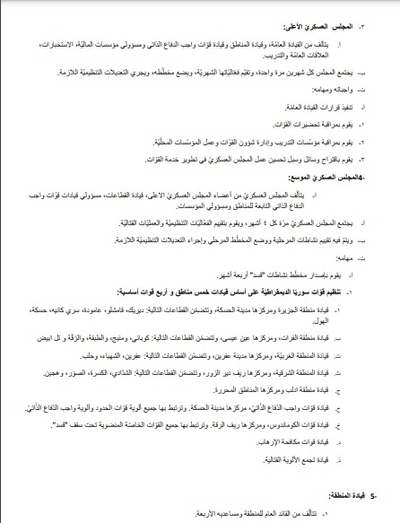
3. The Supreme Military Council:
a) Composed of the General Command, the command of the regions and the command of the forces of the Self-Defence Obligation and the officials of the financial department institutions, the intelligence apparatuses, the public relations and training.
b) The council convenes once every two months, and assesses their monthly activities, and puts in place its plan, and implements the necessary organisational modifications.
c) Its obligations and missions:
d) Implementing the decisions of the General Command.
1. Oversees the preparations of the forces.
2. Oversees the institutions of training and administering the affairs of the forces and the work of the local institutions.
3. Suggests the means and ways to improve the work of the military council in developing the service of the forces.
4. The Expanded Military Council:
a) The military council is composed of members of the Supreme Military Council, the command of the sectors, officials of the commands of the forces of the Self-Defence Obligation affiliated with the regions and the officials of the institutions.
b) The military council meets once every four months, and assesses the organisational activities and combat operations.
c) And in it there is carried out the assessment of phased activities along with putting in place the phased plan and carrying out the necessary organisational modifications.
d) Its missions:
a) Issuing the plan of the ‘SDF’ activities for four months.
1. The organisation of the Syrian Democratic Forces is on the basis of commands of five regions and four foundational forces:
a) Al-Jazeera region command, and its centre is the city of al-Hasakah, and it includes the following sectors: Derik, Qamishlo, Amouda, Sari Kaniyeh, Hasakah, al-Hawl.
b) Euphrates region command, and its centre is Ayn Eisa, and it includes the following sectors: Kobani, Manbij, al-Tabqa, Raqqa and Tel Abyad.
c) Western region command and its centre is the city of Afrin, and it includes the following sectors: Afrin, al-Shahba’ and Aleppo.
d) Eastern region command, and its centre is Deir az-Zor countryside, and it includes the following sectors: al-Shaddadi, al-Kasra, al-Sour and Hajeen.
e) Idlib region command and its centre is the liberated areas.
f) The command of forces of the Self-Defence Obligation, and its centre is the city of al-Hasakah, and all the brigades of the border forces and brigades of the Self-Defence Obligation are connected with it.
g) The command of the Commandoes forces, and its centre is al-Raqqa countryside, and connected with it are all the special forces included under the roof of the ‘SDF.’
h) Counter-Terrorism Forces command.
i) Command of the Grouping of the Combat Brigades.
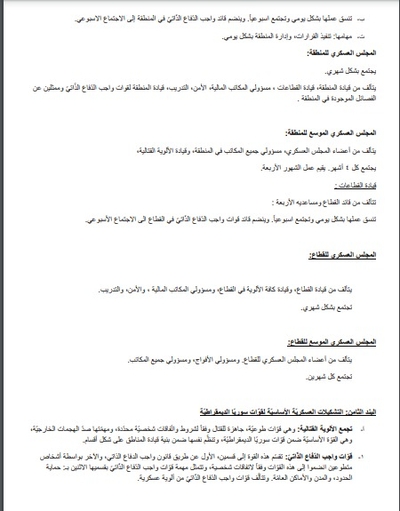
5. The Region Command:
a) Composed of the general commander for the region and his four assistants.
b) Coordinates its work in a daily sense and meets weekly, and the commander of the Self-Defence Obligation in the region joins the weekly meeting.
c) Its missions: implementing the decisions, and administering the region daily.
The Military Council for the Region:
Meets monthly.
Composed of the region command, command of the sectors, officials of the financial offices, security, training, command of the region for the forces of the Self-Defence Obligation and representatives of the factions present in the area.
The Expanded Military Council for the Region:
Composed of the members of the military council, officials of all the offices in the region, and command of the combat brigades.
Meets every four months, assesses the work of the four months.
Command of the Sectors:
Composed of the sector commander and his four assistants:
Coordinates its work daily and meets weekly. And the commander of the forces of the Self-Defence Obligation in the sector joins the weekly meeting.
The Military Council for the Sector:
Composed of the sector command, and command of all the brigades in the sector, and officials of the financial offices security and training.
Meets monthly.
The Expanded Military Council for the Sector:
Composed of the members of the Military Council for the Sector, officials of the regiments, and officials of all the offices.
Meets every two months.
Article Eight: The Foundational Military Formations for the Syrian Democratic Forces
a) Grouping of the Combat Brigades: and they are voluntary forces, ready to fight, in accordance with personal defined conditions and agreements, and their mission is to repel external attacks, and they are the foundational force within the Syrian Democratic Forces, and they organise themselves within the structure of the regions command in the form of divisions.
1. Forces of the Self-Defence Obligation: this force is divided into two divisions: the first through the law of the Self-Defence Obligation, and the other by means of volunteer persons who have joined these forces in accordance with personal agreements, and the mission of the forces of the Self-Defence Obligation is embodied in its two divisions in protecting the borders, towns and public places. And the forces of the Self-Defence Obligation are composed of military brigades.
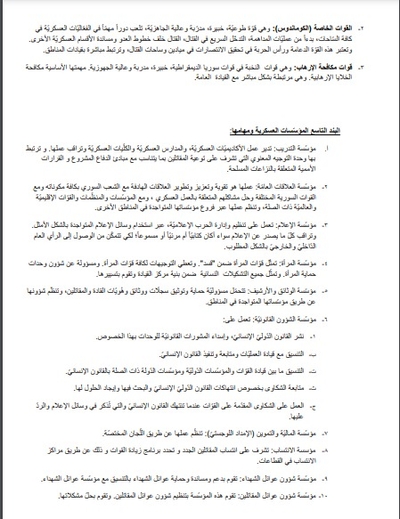
2. The Special Forces (Commandoes): and they are a volunteer force, trained, and of high readiness, playing an important role in military activities in all fields, beginning from assault operations, rapid intervention in the combat, fighting behind the enemy lines and aiding the other military divisions. And this force is considered the pillar and spear-tip in realising the victories in the fields and squares of combat, and it is directly connected with the commands of the regions.
3. Counter-Terrorism Forces: and they are the elite forces in the Syrian Democratic Forces, expert, trained, of high readiness. Their fundamental mission is to combat the terrorist cells, and they are directly connected with the General Command.
Article Nine: The Military Institutions and Their Missions:
1. Training Institution: manages the work of the military academies and the military schools and military colleges and oversees their work. And connected with is the morale directive unit that oversees raising the awareness of the fighters in what accords with the principles of legitimate defence and the international decisions connected with armed conflicts.
2. The Public Relations Institution: their work is to strengthen, reinforce and develop the goal-oriented relations with the Syrian people in all its components and with the various Syrian forces and resolving their problems connected with military work, and with the institutions and organisations and relevant regional and global forces. And it organises its work through the branches of its institutions present in the other regions.
3. The Media Institution: working to organise and administer the media war, through using the media present in the most exemplary form. And it oversees all that is issued from the media whether in writing, visual or audio means, so that it can reach the internal and external public opinion in the desired sense.
4. The Woman’s Institution: represents the Woman’s Forces within the ‘SDF’ and it gives directives to all the Woman’s Forces. It is responsible for the affairs of the Woman’s Protection Units, and it represents all the women’s units within the structure of the command centre and facilitates it.
5. Documents and Archive Institution: bears responsibility for protecting and documenting the records, documents and identities of the commanders and fighters. And it organises its affairs through its institutions present in the regions.
6. Legal Affairs Institution: works on:
a) Spreading international humanitarian law, and provides legal consultations for the units within this regard.
b) Coordinating with the operations command and tracking and implementing humanitarian law.
c) Coordinating between the command of the forces and the international institutions and the relevant state institutions in humanitarian law.
d) Tracking complaints with regards to violations of international humanitarian law and investigating them and finding solutions to them.
e) Working on complaints submitted against the forces when they violate the humanitarian law and which are mentioned in the media, and responding to those complaints.
7. Financial and Provisional Institution (Logistical Support): organises its work through the specialised committees.
8. Affiliation Institution: oversees the affiliation of the new fighters and defines the programs of the increase of the forces and that is through the affiliation centres in the sectors.
9. Institution of the Affairs of the Families of the Martyrs: supports, aids and protects the families of the martyrs in coordination with the Institution of the Families of the Martyrs.
10. Institution of the Affairs of the Families of the Fighters: this institution organises the affairs of the families of the fighters and resolves their problems.
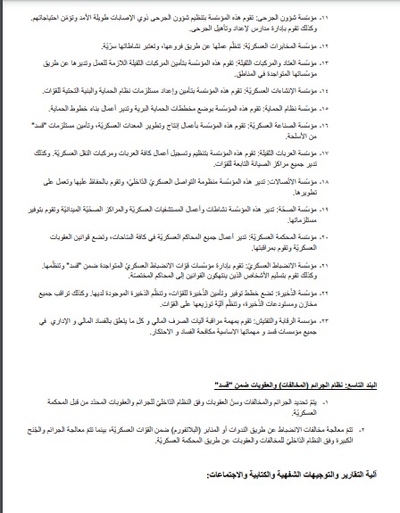
11. Institution of the Affairs of the Wounded: this institution organises the affairs of the wounded who have long-term wounds and secures their needs, and likewise it manages schools to prepare and rehabilitate the wounded.
12. Military Intelligence Institution: organises its work through its branches, and its activities are considered secret.
13. Equipment and Heavy Vehicles Institution: this institution secures the necessary heavy vehicles for work and manages them through its institutions present in the regions.
14. Military Installations Institution: this institution secures and prepares the necessities
of the protection system and infrastructure for the forces.
15. Protection System Institution: this institution puts in place the land protection plans and manages works of building the protection lines.
16. Military Industry Institution: this institution undertakes works of production and development of military equipment, and secures the necessities of the ‘SDF’ from weapons.
17. Heavy Armoured Vehicles Institution: this institution organises and registers the works of all the armoured vehicles and military transportation vehicles, and likewise manages all the repair centres affiliated with the forces.
18. Connections Institution: this institution manages the internal military contact system, and preserves it and works to develop it.
19. Health Institution: this institution manages the activities and works of the military hospitals and the field health centres and provides their necessities.
20. Military Court Institution: manages the works of all the military courts in all the fields, and puts in place the laws of military punishments and oversees them.
21. Military Discipline Institution: manages the institutions of the forces of military discipline present within the ‘SDF’ and organises them. Likewise it hands over the persons who violate the laws to the relevant courts.
22. Ammunition Institution: puts in place the plans to make available and secure the ammunition for the forces, and organises the ammunition present with it, and likewise oversees all the storages and warehouses of ammunition, and organises the means of distributing them to the forces.
23. Oversight and Inspection Institution: undertakes the assignment of overseeing the mechanisms of financial disbursement and all that is concerned with financial and administrative corruption in all the institutions of the SDF and its fundamental assignments are combating corruption and hoarding.
Article Nine: System of Crimes (Violations) and Punishments within the ‘SDF.’
1. The crimes and violations are to be defined with mandating of the punishments in accordance with the internal system for the crimes and punishments defined by the military court.
2. Violations of discipline are to be rectified through the seminars and platforms within the military forces, while the great crimes and delinquencies are to be rectified according to the internal system for the violations and punishments through the military court.
Mechanism of oral and written reports and directives and meetings:
– All the institutions and military formations organise their work from bottom to top according to the mechanism of reports and from top to bottom according to the mechanism of directives and assessment of their work according to regular established meetings:
– Mechanism of reports:
The mechanism of reports, whether oral or written, is divided to three types, including all the administrative and military works on the daily, weekly and monthly basis.
1. The daily reports:
a) All the administrative and field components of the Syrian Democratic Forces from the smallest of its units to its largest are obliged to refer all the reports to the command of the units higher than they are and every administrative or field work about which a report has not been referred, is to be considered unofficial and exposed to the mechanism of accountability.
b) The command of the military councils in the sectors are obliged to compile reports about all the administrative and field works going on in the points of their work through their offices and the command of the brigades affiliated with them and refer reports about the totality of their work in a daily sense to the command of the regional military councils through three official channels, which are the responsibility of the offices, the base command and the sector command. And any administrative or field work about which the relevant commissions are not informed, will expose the relevant officials to the mechanism of accountability.
c) The military councils command in the regions are obliged to refer reports about their field and administrative work to the General Command of the Syrian Democratic Forces through three official channels and they are the offices, base command, and region command. And any administrative or field work about which the relevant commissions are not informed, will expose the relevant officials to the mechanism of accountability.
d) The factions affiliated with the Syrian Democratic Forces are obliged to give daily reports about their administrative and field activities to the command of the Syrian Democratic Forces through the three official channels and they are the offices, base command and faction command.
e) The official channels for reports:
– Offices channel:
All the offices present in the sectors base are obliged to write a daily report through their work and submit it to the base command and that is at the end of its daily work in the base of the military council for the sector and they are obliged at the same time to send a copy of it to the office connected with them in the region command.
All the offices present in the regions base are obliged to write a daily report about their work and submit it to the base command, and that is at the end of their daily work in the base of the military council for the region and they are obliged at the same time to send a copy of it to the base of the General Command.
– Base command channel:
The base command in the sector is obliged to submit daily reports to the offices and present the result of its work to the sector command through an official report and sending a copy of this report to the base command in the area.
The base command in the region is obliged to submit daily reports to the offices and present the result of its work to the region command through an official report and sending a copy of this report to the base command in the General Command.
– The channel of the command of the military councils and the forces:
The military councils command in the sectors is obliged to submit daily reports to the command of the base and the brigades affiliated with it and present the result of its work to the region command through a report.
The military councils command in the regions is obliged to submit the daily reports to the command of the base and the brigades affiliated with it and present the result of its work to the General Command through a report.
The command of the foundational forces in the Syrian Democratic Forces (the Commandoes forces, the forces of the Self-Defence Obligation, the Counter-Terrorism Units) is obliged to submit daily reports about its administrative and field work to the General Command through a report.
Monthly reports:
All the offices, forces and factions affiliated with the Syrian Democratic Forces are obliged to carry out monthly meetings and submit the result of the meetings to higher commissions through oral reports every month and written reports once every two months.
Mechanism of directives:
1. Daily directives:
All the offices in the regions are obliged to assess the daily reports coming to them from the offices of the sectors and submit written directives to the offices of the sectors.
All the offices affiliated with the General Command are obliged to assess the daily reports coming to them from the offices of the regions and submit written directives to the offices of the regions.
The base command in the regions is obliged to give the daily directives to the base command in the sectors in what accords with the content of the reports coming to it daily from the base command in the sectors.
The base command in the General Command is obliged to give the daily directives to the base command in the regions in what accords with the content of the reports coming to it daily from the base command in the regions.
The Syrian Democratic Forces command is obliged to assess the daily reports coming to it from the command of the regions, forces and factions and submit written directives to the command of the regions, forces and factions.
Monthly directives:
All the offices and the General Command of the Syrian Democratic Forces are obliged to submit monthly written directives including the results of the monthly meetings and the monthly plan to the offices of the regions and the command of the regions, factions and forces.
System of daily, weekly and monthly meetings:
All the offices in the sectors, regions and the General Command and the forces assess their daily work in the framework of information and reports coming to them on a daily basis and they present their result through a report to the base command in the sector, region and General Command.
The base command in the sector, region and the General Command meets daily to assess the daily reports of the offices.
The General Command and the region command and sector command and command of the forces meet daily with their members present along with the participation of the base command to assess the incoming reports and the daily work of all the military and administrative activities in the points of their work.
The base command in the sector, region and the General Command carries out a weekly meeting of all the officials of the offices affiliated with it to assess the weekly work of the offices.
All the offices in the sectors, regions and the General Command and the forces assess their weekly work in the framework of information and reports coming to them on a weekly basis and they present their result through a report to the base command in the sector, region and General Command.
The base command in the sector, region and the General Command meets weekly to assess the daily reports of the offices.
The General Command, the Region Command, the Sector Command and the Forces Command meet weekly with their members present along with the participation of the base command to assess the incoming reports and the weekly work of all the military and administrative activities in the points of their work.
All the offices in the sectors, regions and the General Command and the forces assess their monthly work in the framework of the information and reports coming to them through a monthly meeting.
The base command in the sector, region and the General Command meets monthly with the officials of the offices affiliated with it to assess their monthly activities.
The sector command holds an expanded meeting once every two months for the Military Council for the Sector, including the commanders of the regiments and the command of all the brigades present in the sector and the officials of the offices and between two expanded meetings it holds a monthly meeting for the Military Council for the Sector including all the command of the brigades present in the sector and the base command and the officials of the offices of training, finance and intelligence apparatuses.
The region command holds an expanded meeting once every two months for the Military Council for the Region, including the command of the sectors and the forces present in the region and the officials of the offices in the region, and between two expanded meetings it holds a monthly meeting for the Military Council for the Region including the command of the sectors and the forces present in the region and the base command and the officials of the offices of training, finance and the intelligence apparatuses for the region. And every four months it a seasonal meeting is held with the attendance of the commands of the region and the sectors and the forces present in the region and all the brigades alongside the officials of the base command and all the officials of the offices on the region level.
The General Command for the Syrian Democratic Forces holds once every two months an expanded meeting for the Military Council for the Syrian Democratic Forces including the command of the regions and the forces and the factions and the base officials and all the offices affiliated with it, and between two expanded meetings a monthly meeting is held for the Military Council for the Syrian Democratic Forces including the command of the regions and the forces and the base command and the officials of the offices of training, financing, intelligence apparatuses and the public relations affiliated with them. And every four months there is held a seasonal military for the General Military Council with the attendance of the commands of the region, sectors, forces and factions alongside the officials of the General Command base and all the officials of the offices on the level of the General Command.
– Decisions connected with promotions and removal:
The institutional work is the organising framework for decisions of promotion of rank or removal from work, and in accordance with the practical standards and the institutional serialisation the decision is taken, and therefore no one at all has the right to neglect the institutional work in what concerns with the aforementioned.
Promotion
The regiments command is authorised to appoint the commanders of the contingents and factions.
The brigades command is authorised to appoint the command of the squadrons and the battalions.
The sector command is the one authorised to appoint the regiments command and the officials of the offices in the sector.
The region command is the one authorised to appoint the brigades command and the officials of the offices in the region.
The border forces command is authorised to appoint the brigades command in its forces.
The General Command is authorised to appoint the sectors command and the regions command in the border forces.
The General Military Council is authorised to appoint the region command and the forces command.
Removal
All mechanisms connected with appointments apply to what is concerned with removal as well, provided that that is accompanied with a suggestion coming from the relevant institution.
Mechanism of joining, imprisonment, expulsion from the ranks of the forces.
The internal system is the standard that defines the foundations of joining, or arrest or expulsion from the ranks of the forces, provided that that is accompanied with the agreement of the relevant institution, and with the exception of the emergency cases no one has the right to take a decision of including or imprisoning or expelling members within the ranks of the forces. And therefore:
Mechanism of joining:
The forces recruit those who join according to their needs and in a programmatic way, provided that they adopt the general internal system as a standard for that.
The person who joins does not acquire the criterion of membership before undertaking and completing his training course.
Expulsion from the ranks of the forces:
Expulsion from the ranks of the forces must be supplemented by the suggestion of the investigation committee and the decisions of the platform and the military court after the agreement of the command upon that. Therefore:
The brigades command is authorised to agree on the expulsion of fighters.
The sector command is authorised to agree on the expulsion of commanders of the contingents and factions.
The region command is authorised to agree on the expulsion of commanders of the squadrons and the battalions.
The General Command is authorised to agree on the expulsion of commanders of the regiments and the brigades.
The Military Council is authorised to agree on the expulsion of commanders of the fields and regions, and the commanders of the forces not connected with the regions.
Mechanism of arrest:
The arrest is done in relying on the foundations of the internal system of the Syrian Democratic Forces, and that is after the higher commands agree, and in the event arrest is carried out in a direct sense in exceptional circumstances the higher commissions are to be informed and their agreement is to be taken on the same day.
Mechanism of referral of reports and issuing the commands:
The referral of reports and issuing of commands and various organisational and practical activities in the SDF are subjected to the internal system, and therefore:
All the commanders and administrations deal with their competencies and take their decisions according to the internal system and the commands of the General Command, and are obliged at the same time to refer their reports including all their activities to the higher rank.
No work or activity is to be taken into account if it has not been documented, archived and referred to the higher rank in the reports.
Matters connected with the commands of the leadership and the decisions taken in the meetings in a written form and which require agreement on them from the higher leadership, must be implemented in coordination with the relevant leadership with obtaining of agreement with regards to them. And every violation of that requires opening an investigation regarding the violation.
All commands, reports and activities must be documented and archived in writing.
All activity not documented and archived is not to be taken into account.
Mechanism of connections:
Connections directly impact the security of the military forces and therefore they must be professional, and therefore:
All reports and discussions connected with organisational work and practical activities must be processed within the official network of military connections.
It is forbidden to use civilian means of connection in military work and its activities, and every violation necessitates investigation and punishment.
Smartphone devices are forbidden.
The civilian connections network is to be used for personal things and outside the framework of organisational or military work.